Fixed – 401 Unauthorized error while calling Dynamics 365 Web API


We were recently getting the below error while trying to call Dynamics 365 Web API through Postman.

“401 Unauthorized”

It turned out that we were using the incorrect Token.

To generate the correct token,

For OAuth 2.0 token endpoint (v1) Version 1

  • We need to specify resource with Dynamics 365 URL.


For OAuth 2.0 token endpoint (v2) Version 2

  • We need to specify scope with
    Dynamics 365 URL followed by .default instead of a resource.

The correct token results in the successful call to the Web API

References –

https://matthijs.hoekstraonline.net/2020/04/27/v1-and-v2-identity-and-access-tokens-with-azure-active-directory/

https://crmchap.co.uk/generating-oauth2-v2-0-endpoint-tokens-for-dynamics-365-the-common-data-service/

Hope it helps..

Advertisements

How to – Check user’s access to a record – upcoming feature in Dynamics 365


Was going through the Model-Driven Apps documentation and found the below article

https://docs.microsoft.com/en-us/powerapps/user/access-checker

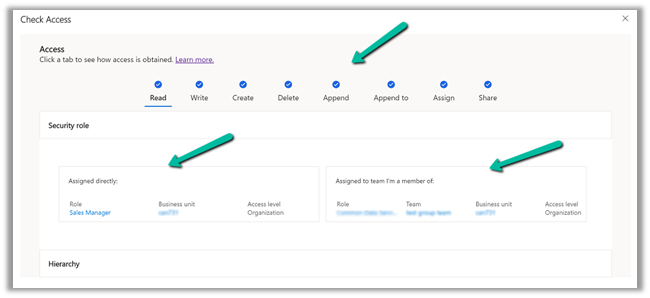
It talks about a Check access button on the command bar of a record which will list down all the rights/access/privileges on that particular record.

And also how the user has got those accesses, through security roles directly assigned or through the team the user belongs.

We can also check the access of the other users as well through user lookup.

More on Access in Dynamics 365

Hope it helps..

Advertisements
Advertisements

5000 records limit of Fetch XML Query – List records action of Common Data Service (current environment) connector in Power Automate


Recently in one of our requirements, while trying to fetch contact records using Fetch XML Query

https://docs.microsoft.com/en-us/connectors/commondataserviceforapps/#list-records

we realized that we can only retrieve / fetch 5000 records.

Enabling pagination will also not help here (the Next link also come as null).

The alternate solution is to convert the Fetch XML query to OData and use the same inside List records action

https://fetchxmlbuilder.com/features/#render-flow

Get more details here

https://evolved365.com/2020/10/06/working-with-large-cds-datasets-in-power-automate-flows-and-logic-apps/

Hope it helps..

Advertisements

User multiplexing- SSIS (KingswaySoft) + Dynamics 365 CE / CDS / Dataverse


Must read article on managing API limits

Thanks – Gustaf Westerlund

How to – Use CrmServiceClient to execute web request against Web API – Dynamics 365


In the previous post we saw how to use CrmServiceClient to connect to CDS using Authentication Type – OAuth and execute web request using Organization.svc service

https://nishantrana.me/2020/11/09/sample-code-to-connect-to-cds-dynamics-365-ce-using-oauth/

Here we will extend the same example to execute web request using Web API.

  • Create the contact record with first name and last name populated

using Microsoft.Xrm.Tooling.Connector;
using Newtonsoft.Json.Linq;
using System;
using System.Collections.Generic;
using System.Linq;
using System.Net.Http;

namespace SampleConsoleApp
{
class Program
{
static void Main(string[] args)
{
string ConnectionString = "AuthType = OAuth; " +
"Username = [username]@[domain].onmicrosoft.com;" +
"Password = [password]; " +
"Url = https://[orgname].crm.dynamics.com;" +
"AppId=51f81489-12ee-4a9e-aaae-a2591f45987d;" +
"RedirectUri=app://58145B91-0C36-4500-8554-080854F2AC97;" +
"LoginPrompt=Auto";

CrmServiceClient svc = new CrmServiceClient(ConnectionString);

// specify OData Headers
Dictionary<string, List<string>> odataHeaders = new Dictionary<string, List<string>>
{
{ "Accept", new List<string>() { "application/json" } },
{ "OData-MaxVersion", new List<string>() { "4.0" } },
{ "OData-Version", new List<string>() { "4.0" } }
};

if (svc.IsReady)
{
// create a contact record with firstname and lastname populated
dynamic contact = new JObject();
contact.firstname = "Meeska";
contact.lastname = "Mooska";
string jsonContact = Newtonsoft.Json.JsonConvert.SerializeObject(contact);

// create the contact record
// Parameters - HttpMethod, QueryString, Body, Customer Headers, Content Type
HttpResponseMessage httpResponse = svc.ExecuteCrmWebRequest(
HttpMethod.Post,
"contacts",
jsonContact,
odataHeaders,
"application/json");

if (httpResponse.IsSuccessStatusCode)
{
var contactUri = httpResponse.Headers.GetValues("OData-EntityId").FirstOrDefault();
Console.WriteLine("Contact URI: {0}", contactUri);
}
else
{
Console.WriteLine(httpResponse.ReasonPhrase);
}
}
}
}
}

  • Retrieve first name and last name for all the contact

// retrieve first name and last name of all the contact records 
HttpResponseMessage httpResponse = svc.ExecuteCrmWebRequest(
HttpMethod.Get,
"contacts?$select=firstname,lastname",
string.Empty,
odataHeaders,
"application/json");

Refer appropriate connection string as required with CrmServiceClient- 

https://docs.microsoft.com/en-us/powerapps/developer/data-platform/xrm-tooling/use-connection-strings-xrm-tooling-connect#connection-string-examples

Sample Code – Dynamics 365 Web API / Organization Service

Get the details here – ExecuteCrmWebRequest

Hope it helps..

Advertisements

Process Optimization – Dynamics 365 CE / CRM / CDS SSIS Integration toolkit – KingswaySoft


Process Optimizations is a new feature added in the CDS / CRM Destination Component of KingswaySoft’s SSIS Integration Toolkit as part of November 2020 Release.

Check other posts on SSIS and Dynamics 365

https://nishantrana.me/2020/10/16/ssis-kingswaysoft-and-dynamics-365/

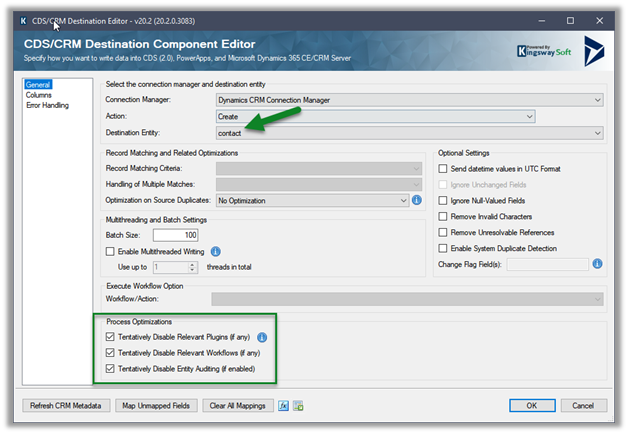
These options if enabled, will turn off or disable plugin, workflow, entity auditing during pre-execution temporarily, during the writing process, and will revert the changes to the original state after successful execution.

  • Tentatively Disable Relevant Plugins (if any)
  • Tentatively Disable Relevant Workflows (if any)
  • Tentatively Disable Relevant Auditing (if any)

Let us take a simple example to see it in action.

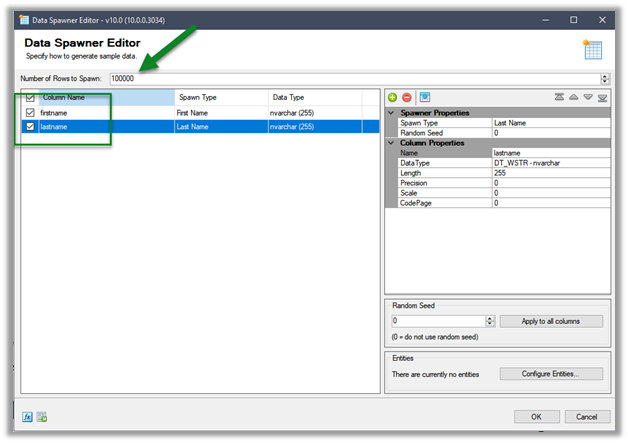
Here we have a simple data flow that creates contact records inside CDS using Data Spawner.

https://nishantrana.me/2020/05/26/using-data-spawner-component-ssis-to-generate-sample-data-in-dynamics-365/

Let us run the package and see the status of the plugin, workflow, and audit with regards to the contact entity.

As expected, we do not see any Audit records created for contact records creation.

We see an event where Audit is disabled and then enabled later for the contact entity, during the duration of package running and after its successful completion.

We can also see our workflow in status – Draft

In the case of Plugin, we didn’t see the step being disabled and it was still being triggered

As per the documentation –

Get the toolkit here

https://www.kingswaysoft.com/products/ssis-integration-toolkit-for-microsoft-dynamics-365

Hope it helps..