How to – Use the new command designer to customize the command bar – Dynamics 365 / Power Apps


Using the modern app designer either open an existing model-driven app or create a new model-driven app in https://make.powerapps.com/

Select Edit >> Edit in preview

Select any entity/table and select the Edit command bar (preview)

The different command bars that can be edited are the Main grid, main form, subgrid view, and the associated view.

  • Main Grid view

  • Main Form view –

  • Subgrid view–

  • Associated view –

The legacy / classic button is not supported currently.

Check out all the known limitations

https://docs.microsoft.com/en-gb/powerapps/maker/model-driven-apps/command-designer-limitations

limi

Let us try adding a new command/button in the Main Form, and see what options do we get there.

Select + New command or the + New option

It adds a new button with the label NewCommand with options to duplicate, hide, move up and down, etc.

The different properties that can be configured for the new command –

Property

Description


Label

To set the label

Icon

To set the icon either using icon or web resource

Tooltip

Set tooltip title and its description.

Order Number

Customize the Order of the command

Action

Either run formula or run javascript


Open Formula Bar


Library for Run JavaScript

Visibility


Open Formula Bar for Show on Condition

Let us Save and Publish

Click on Play and open a lead form.

We can see the new command added.

Get all the details here –

https://docs.microsoft.com/en-gb/powerapps/maker/model-driven-apps/command-designer-overview

Hope it helps..

Advertisements

Use ExecuteWorkflowAction to call Action and Workflow in CDS Destination KingswaySoft – Dynamics 365 / Dataverse


We can use ExecuteWorkflowAction in the CDS/CRM Destination Component of KingswaySoft’s SSIS Integration Toolkit for Dynamics 365 to execute workflow and custom action.

If there is no Destination Entity defined (left blank), Workflow/Action options will list down all the global action available


On selecting a specific entity/table e.g. lead entity, it is listing down the actions tied to the lead entity and the on-demand workflows created for the lead.

Here new_TestLeadAction is a custom action and Test Lead Workflow On-Demand is an On-Demand Workflow.


Suppose we have the following input and output parameters defined in the custom action.


Within the CRM Destination Component, we can see the input fields listed for mapping along with the LeadId field where it expects the GUID of the lead record to be passed, against which action has to be executed.


Let us create a custom Global Action – Test Global Action and see if it is listed there or not.


We can see the custom global action listed when there is no destination entity selected as we saw earlier.

However, we also get the error that the Entity as input argument is not supported.


We get the same error for the input parameter of type Entity Collection.


For Entity Reference input it works properly and expects Entity Ref and Entity Ref Type to be passed.

We have removed the input parameter of type Entity and Entity Collection and added an output parameter named SampleOutput.

Surprisingly within our SSIS package, we could not figure out to get the output parameter’s value back from the Action.


We asked KingswaySoft Technical Support (support@kingswaysoft.com), and as usual, within a couple of hours the experts there were able to confirm our understanding that output parameters are not supported in the CDS Destination component for now.

Check other posts on KingswaySoft and Dynamics 365 / CRM https://nishantrana.me/2020/10/16/ssis-kingswaysoft-and-dynamics-365/

Hope it helps.

Advertisements

Set Auto Number field value conditionally in Dynamics 365 / Dataverse


Recently we had a requirement to use auto numbers for lead records.

However, based on where the lead records are being created from, we wanted to specify a different prefix to it.

For leads created manually, the format should be prefixed “L” followed by “– “and then 10 digit sequence number.

L-{SEQNUM:10}

And if created through API the prefix should be B.

B-{SEQNUM:10}

To achieve this, we can define an auto-number field with the following format.


Next, we can have a bool field (default – false) in the lead table, to identify if it is being created from the API, which we can set while creating the lead record through API.

And a Pre Create Plugin on Lead to check the value of that field.

If it is set (true), that we can replace the Prefix from L to B in the auto-number field within the context.

In the Pre Create plugin, we get the next sequence in the auto-number field, so simply replacing/setting the value of the auto numbering field did the trick.

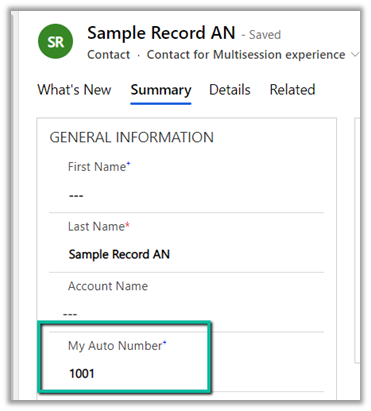
Lead created through Web Application –

Lead created through API –

Here uniqueness was more important than the next sequence of the lead record so this solution worked.

Also check –

https://jonasr.app/2020/03/anm-unique-seq/

https://nishantrana.me/2021/11/09/few-key-points-auto-number-field-in-dataverse-dynamics-365-ce-crm/

Hope it helps..

Advertisements
Lookup Behavior – Minimum character to trigger search and delay between trigger – Dynamics 365


Within Power Platform Admin Center – (https://admin.powerplatform.microsoft.com/)  through Environments >> [Name] >> Settings >> Behavior >> Lookup Behavior settings we can control the minimum number of characters entered before triggering the search in the and delay before the search is triggered for the lookups.

  • Minimum number of characters to trigger typeahead search – Default (2)
  • Delay between character inputs that will trigger a search – Default (250ms)

Here we have updated the value to 5 and 5000 respectively for our testing.

The result –

Lookup Behaviour

After 5 characters are entered, it waits for 5 seconds before searching (loading..)

Also check –

https://nishantrana.me/2021/06/22/advanced-lookup-in-model-driven-power-apps-dynamics-365/

https://docs.microsoft.com/en-us/power-platform/admin/settings-behavior

Hope it helps ..

Advertisements

Few key points – Auto Number field in Dataverse (Dynamics 365 CE / CRM)


  • Can we convert the existing text field to the Auto Number field?

Yes, e.g. we can update the Last Name attribute of the lead’s data type to be of Auto number from Text.

  • Can we convert the auto number field back to the normal text field?

Yes


  • Can the auto number field have duplicate values?

Yes, the platform allows having more than one record to have the same value. It doesn’t throw an error.

Multiple lead records have null values for the auto number field as shown below.

  • What if the Seed value increases than the digits specified?

The platform will assign the next value and will not throw an exception.

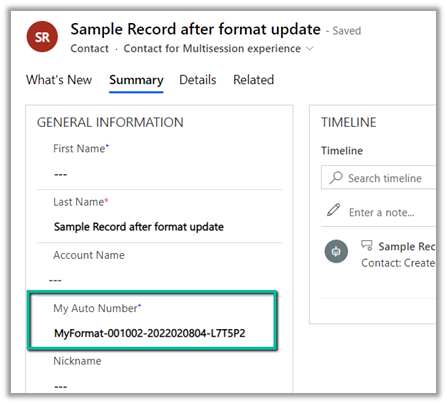
  • Can we change the format of the existing auto number field?

Yes

It will affect any new records created.

  • What other things we can do with the auto number fields?

We can make the field readonly in the form so that users do enter the values manually, we make the field required and for uniqueness, we can enable alternate keys on it.


  • What is the min and max length of the RANDSTRING placeholders?

Between 1-6

  • What about maximum seed value?

The auto number field is similar to a text field, it is different in that it generates a unique number when there is no value specified for it.

Get all details here –

https://docs.microsoft.com/en-us/powerapps/developer/data-platform/create-auto-number-attributes

https://jonasr.app/2017/10/anm/

Hope it helps..

Advertisements

Route Case (routecase) attribute and msdyn_ApplyRoutingRuleEntityRecord Action in Dynamics 365 Customer Service


The case entity/table in Dynamics 365 CE has a Boolean type field named Route Case.

It has a default value as Yes.

On manually creating the record from the user interface, although Route Case shows the default value as Yes

On saving the record, the value changes to No, the field is also locked.

So basically no routing rules are applied when a case record is created from the user interface.

To apply routing rules, we need to use the “Save and Route” option

Or “Apply Routing Rule” command from the Grid

This also however will not update or set the Route Case field to Yes on the case record.

Now if we create the case record programmatically, the field would be set and saved with its default values as Yes.
The same goes for cases created from Flow.

Route Case is set to Yes.

So basically routing rules will be triggered on the records created from outside the User Interface as Route Case will be set Yes for those records.

Now if we want to run the routing rules against the case record created from the user interface, we can make use of the following action –

msdyn_ApplyRoutingRuleEntityRecord

Within Flow –

Within Plugin or any custom code–

msdyn_ApplyRoutingRuleEntityRecord can be used for other entities apart from the case.

In the case of Case entity, we can also make use ApplyRoutingRule action also.


Hope it helps..


Advertisements