Using MediaWiki API for Showing content of Wikipedia page inside Dynamics 365 form


Hi,

Recently we had a requirement to show content of Wikipedia page and display it inside CRM in one of the entities form.

For this purpose, we can make use of “MediaWiki web service API.”

https://www.mediawiki.org/wiki/API:Main_page

To create the query, we can use the below tool

https://en.wikipedia.org/wiki/Special%3aApiSandbox

The html source code


<!DOCTYPE html>
<html xmlns="http://www.w3.org/1999/xhtml">
<head>
<title></title>
<script src="https://ajax.googleapis.com/ajax/libs/jquery/3.1.1/jquery.min.js"></script>
<script type="text/javascript">

function SetWikiContent() {

// get country name from crm form
if (Xrm.Page.getAttribute("new_name") != null) {

var title = Xrm.Page.getAttribute("new_name").getValue();

// set the url
var url = "https://en.wikipedia.org/w/api.php?format=json&action=parse&page=" + title + "&prop=text&section=0&callback=?";

$.getJSON(url, function (data) {
for (text in data.parse.text) {
var text = data.parse.text[text].split("
");
var pText = "";

for (p in text) {
//Remove html comment
text[p] = text[p].split("<!--");
if (text[p].length > 1) {
text[p][0] = text[p][0].split(/\r\n|\r|\n/);
text[p][0] = text[p][0][0];
text[p][0] += "
 ";
}
text[p] = text[p][0];

//Construct a string from paragraphs
if (text[p].indexOf("
") == text[p].length - 5) {
var htmlStrip = text[p].replace(/<(?:.|\n)*?>/gm, '') //Remove HTML
var splitNewline = htmlStrip.split(/\r\n|\r|\n/); //Split on newlines
for (newline in splitNewline) {
if (splitNewline[newline].substring(0, 11) != "Cite error:") {
pText += splitNewline[newline];
pText += "\n";
}
}
}
}
pText = pText.substring(0, pText.length - 2); //Remove extra newline
pText = pText.replace(/\[\d+\]/g, ""); //Remove reference tags (e.x. [1], [4], etc)

Xrm.Page.getAttribute('new_wikiinfo').setValue(pText);
}
});
}
}

</script>
</head>
<body onload="SetWikiContent();">
</body>
</html>

The helpful article

http://stackoverflow.com/questions/8555320/is-there-a-clean-wikipedia-api-just-for-retrieve-content-summary

Hope it helps..

Simple Bing Map HTML Web Resource to show Country location in Dynamics 365


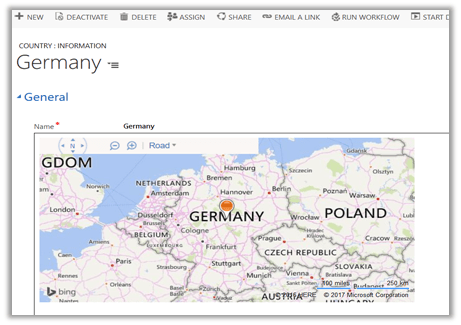
Just sharing a HTML Web resource code to show Country location inside the map using name of the country.

Source Code: –


<!DOCTYPE HTML PUBLIC "-//W3C//DTD XHTML 1.0 Transitional//EN" "http://www.w3.org/TR/xhtml1/DTD/xhtml1-transitional.dtd">
<html>
<head>
<title>My Bing Map</title>
<script charset="UTF-8" type="text/javascript" src="https://ecn.dev.virtualearth.net/mapcontrol/mapcontrol.ashx?v=7.0&s=1"></script>
<script type="text/javascript">
var map = null;

// get the bing map key https://msdn.microsoft.com/en-us/library/ff428642.aspx
var credentials = "AvYH87t36Tv3ybyYagU9HUZKjsrWO2Hcup3nu1fmNhpenHKO_xxxxx";

function GetMap() {

// countryName - name of the country from the CRM's form
var countryName = parent.Xrm.Page.getAttribute("new_name").getValue();

// calling virtual earth api
var geocodeRequest = "https://dev.virtualearth.net/REST/v1/Locations?countryRegion=" + countryName + "&key=" + credentials + "&jsonp=GeocodeCallback";

CallRestService(geocodeRequest);
}

function GeocodeCallback(result) {

if (result && result.resourceSets && result.resourceSets.length > 0 && result.resourceSets[0].resources && result.resourceSets[0].resources.length > 0) {

var coordinates = result.resourceSets[0].resources[0].point.coordinates;
var centerPoint = new Microsoft.Maps.Location(coordinates[0], coordinates[1]);

map = new Microsoft.Maps.Map(document.getElementById("mapDiv"),
{
credentials: credentials,
center: centerPoint,
mapTypeId: Microsoft.Maps.MapTypeId.road,
zoom: 5
});

var pushpin = new Microsoft.Maps.Pushpin(map.getCenter());
map.entities.push(pushpin);
}
}

function CallRestService(request) {
var script = document.createElement("script");
script.setAttribute("type", "text/javascript");
script.setAttribute("src", request);
document.body.appendChild(script);
}
</script>
</head>
<body onload="GetMap();">
<div id='mapDiv' style="position: relative; width: 600px; height: 300px;"></div>
</body>
</html>

Check this helpful post as well

https://blogs.bing.com/maps/2015/03/05/accessing-the-bing-maps-rest-services-from-various-javascript-frameworks/

Hope it helps..

SSRS Fetch XML based CRM Online Report performance in Dynamics 365


Hi,

Recently we were analyzing the performance of a fetch xml based online report.

The report was running against opportunity, and had 4 data set in it. Custom entity A and custom entity B were n – 1 related to opportunity.

Data Set Opportunity 13000 records
Data Set for Custom Entity A used for Lookup 100 records
Data Set for Custom Entity B used for Lookup 8000
Data Set for Tasks Activity used for Lookup 130000 records

More on Lookup Function in SSRS

Running without filter 107 seconds
Filter Last 6 months 94 seconds

We then updated the report’s design, to include only one Dataset by using link entities in the main dataset’s fetch xml. We got the below result

Running without filter 280 seconds
Filter Last 6 months 10 seconds

Another variation we tried was having two Dataset, one for opportunity and another one for tasks to be used for lookup.

Running without filter 50 seconds
Filter Last 6 months 50 seconds

The last variation we tried was using only one Dataset for Opportunity in the main report and the drill down report for Tasks

Running without filter 34 seconds
Filter Last 6 months 7 seconds

It clearly shows that the most efficient way of implementing is through the usage of drill down report, only glitch here is user needs to click on the main report to get the details.

Using single dataset is efficient for subset of records, however it can take long time if it runs on huge number of records in which case lookup performs better.

Basically,

g

Hope it helps..

Resources in Use -300 Custom Entities Limit in Dynamics 365 (online)


Hi,

Till CRM 2015 update 1, we had upper limit of 200 Workflows, 300 Dialogues and 300 Custom Entities. From CRM 2015 Update 1 onwards, the limit of workfows, dialogues and custom entities have been removed.

In Dynamics 365 Online we can still see information related to custom entities which shows upper limit as 300. However this is more of indicative and there is no upper limit now. Please refer the below link for more details

https://technet.microsoft.com/en-us/library/88b18946-474c-4c94-8e4c-27532f930757?f=255&mspperror=-2147217396#Anchor_4

Go to Settings –> Administration –> Resources in Use

riu

Hope it helps..
Quick Walkthrough – Editable Grid in Dynamics 365.


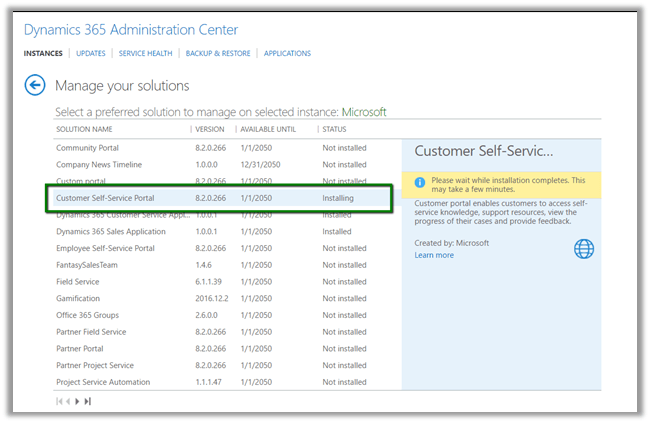
Let us try exploring Editable Grid in Dynamics 365

We’d enable it on Contact Entity ( editable grid works for custom entities as well)

  • Go to Contact entity, control tab and click on Add Control

  • Add Editable Grid

  • Enable Editable Grid as default for Web, Phone and Tablet

  • Save and Publish the change.
  • Go to Contact Home Grid. (fields now can be edited, Status, Composite fields etc are not editable)

  • We can do Group By on the grid

  • Similarly, in Associated View of Contact we have the same behavior

  • To switch back to Read Only Grid, select SHOW AS command

  • Back to our old Read Only Grid (no grouping)

  • We can add JScript for fields inside grid.
  • Let us try Adding function on OnChange of Address 1: City field inside Editable Grid

  • On changing the City field in the grid

For Subgrid,

subgrid.png

sg1.png

Hope it helps..

Sample Code to use UpsertRequest in CRM 2015\2016


UpsertRequest was a new request introduced in CRM 2015 Online Update 1.

The request based on the alternate key specified, looks for the record, if the record is existing it updates it else it creates a new record.

https://nishantrana.wordpress.com/2016/10/25/alternate-keys-in-crm-2015crm-2016/

UpsertResponse has a property named RecordCreated which is false if the record is found and updated else it is true if record is created. The Target property holds the reference of the record created or updated.

Suppose we have following record created. It has Alternate key defined on “Alternate Key Field”

Sample Code

As we have demo entity record with alternate key field having value as “My Alternate Key 1” it will update the record.

Running it again this time changing the value for the alternate key field.

It creates a new record.

Hope it helps..