Autonumber field values in case of exception in Dynamics 365 / CRM


Recently in one of our projects, where we were using the auto number attribute (with sequential numbers), we realized that it gets incremented even in case of an exception thrown during Pre Stage of the Plugin Execution. We were assuming the number gets incremented only after the record gets created i.e. on post-stage.

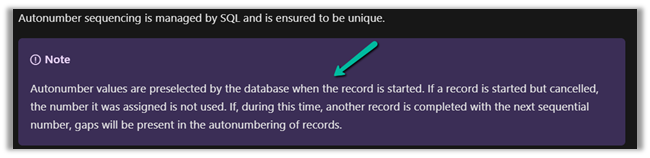
But as the documentation mentions, the number gets pre-selected as soon as the record is started.

https://docs.microsoft.com/en-us/power-apps/maker/data-platform/autonumber-fields

Let us see it in action also –

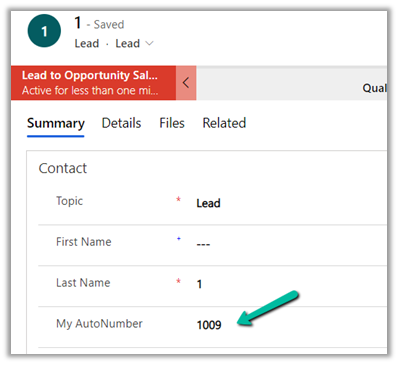
Here we have the lead record created with My Autonumber as the auto number column with seed as 1000

The auto number field has a value of 1009 currently.

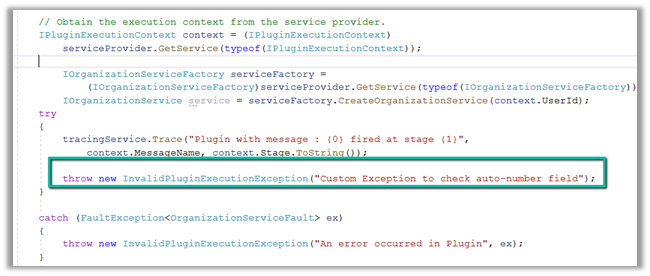
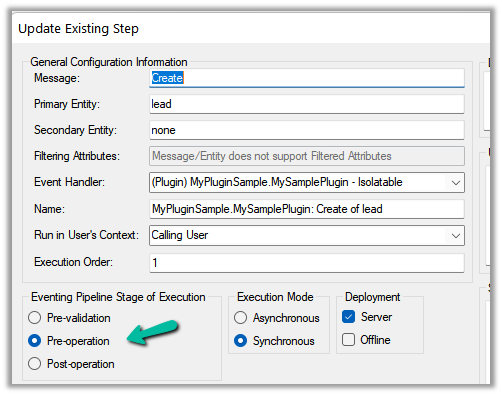
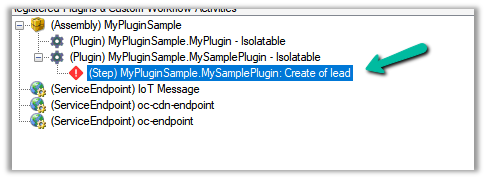
Now let us register a plugin on the Pre-Create stage that throws the exception.

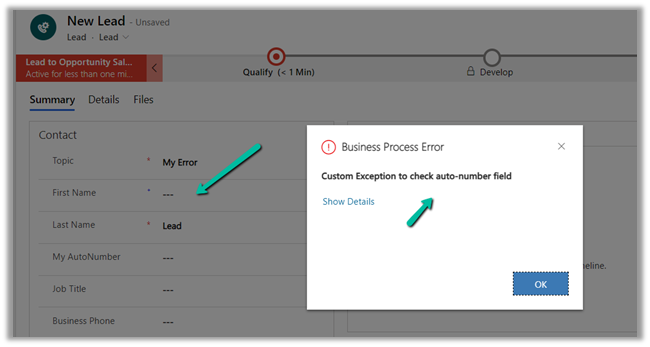
Let us try creating a new lead record, which as expected will throw the exception.

Let us try saving the record 3 times more, triggering the record creation as well as the plugin along with the exception.

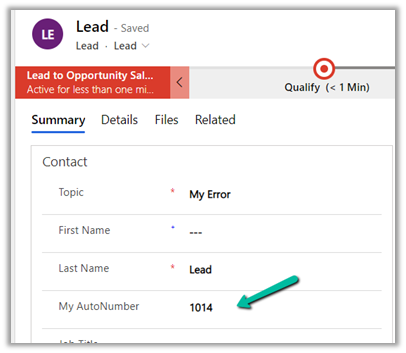
Now let us disable the plugin step and save/create the record.

As expected the record gets created, and the auto number field has a value of 1014.

The same behavior was observed in case of Pre-Validation stage.

Hope it helps..


Advertisements

Fixed – Sorry, we need additional information to verify your identity. Please Contact Support error while creating Dynamics 365 Trial


Recently while creating a Dynamics 365 Trial, https://dynamics.microsoft.com/en-us/dynamics-365-free-trial/, we were getting the below error, during the verification step

“Sorry, we need additional information to verify your identity. Please Contact Support”


This error could be related to the same phone number being used multiple times to create the Dynamics 365 trial or could be related browser cache.

Before trying with a new phone number, we should first try creating a trial in the In-Private mode (or clear cache in the browser).

In our case, the In-Private mode worked as shown below, and we were able to create the trial.

Hope it helps..

Advertisements

Fixed – You can’t delete this queue because it has items assigned to it – Dynamics 365 Customer Service Hub / CRM


Recently while trying to delete some of the Queue (Advanced Queue) in our case, we were getting the below error.

You can’t delete this queue because it has items assigned to it. Assign these items to another user/team, or queue and try again.

We checked and there were no queue items assigned to that queue.

Eventually what worked was to Deactivate that Queue first and then we were able to delete it.

Hope it helps..

Advertisements

How to – Share read-only links to records with any user in your organization – Dynamics 365 / CRM (Dataverse)


To enable quick sharing of the read-only link of the records to any users within the organization, log in to Power Platform Admin Center

Select the Environment > Settings > Privacy + Security


Switch On the Enable Sharing option


This option currently works on the Contact, Account, Opportunity, and Case table.

It enables the option of sending the link to the record with

  • People in the organization with the link
  • Specific People

apart from

  • People with existing access.

Clicking on the Copy link opens the below model dialog box –

Clicking on People with existing access opens the below options –

  • People in your organization with the link
  • Specific people (disabled)

Here we have selected “People in your organization with the link

This enables any user (even if he has no CRM License or Dynamics 365/ Power Platform Role assigned) with the link to open the record as read-only.

This is how the record has opened for the user having no access to CRM but having the link to the record. (read-only)

Similarly, Email Link opens the Send Link dialog box, which allows us to select either a User(s) or Team(s) and define the content of the message as shown below

Clicking on Send opens the email in the default Mail Client associated

Here also we have the option to select either People in your organization with the link and Specific People


Get more details –

https://docs.microsoft.com/en-us/power-platform-release-plan/2022wave1/power-apps/easy-record-sharing

Hope it helps..

Advertisements

How to – Use Refresh Option to force user state synchronization in Power Platform Admin Center – Dynamics 365 / CRM


At times we would assign or update the licenses and roles assigned to the users in Microsoft 365 Admin Center, and these changes would take time to reflect inside the Dynamics 365 applications.

A background system process takes care of synchronizing the user state in Azure AD to the System User table in Dataverse.

However, here we can also use the Refresh
User option in Power Platform Admin Center to force the synchronization instead of waiting.

Inside Power Platform Admin Center – Navigate to Environment >> [Env]>> Settings >> Users and select the user and click on Refresh user option.

This will immediately start the synchronization process.

Hope it helps..

Advertisements

Sample Code to Approve Email – Mailbox programmatically C# (Dynamics 365/CRM)


Suppose we want to Approve the Email for the mailbox of the user(s) programmatically.

We’d see the below notification for the user whose mailbox is not yet approved.

Email won’t be processed for this mailbox until the email address of the mailbox is approved by an Office 365 Global Administrator or by an Exchange Administrator. For more information, contact your system administrator.

Below is the sample code –

On running the code, we can see the notification for the email address approval removed or the mailbox approved for the user.

C# Code –

            CrmServiceClient svc = new CrmServiceClient(ConnectionString);

            if (svc.IsReady)
            {

                var systemUser = new Entity("systemuser", new Guid("C48A539A-F493-EC11-B400-000D3A4F37D3"));

                // emailrouteraccessapproval - status of the primary email address
                //0	= Empty, 1 = Approved, 2 = Pending Approval, 3 = Rejected
                systemUser.Attributes["emailrouteraccessapproval"] = new OptionSetValue(1);

                svc.Update(systemUser)

The code should run under the context of the user who has either Global Admin or Exchange Admin role.

Hope it helps..

Advertisements