Use Security Roles to manage access to views (preview)– Dataverse / Dynamics 365


Sometimes, we might create a new view for a table, and not everyone in our organization needs to see it — or maybe, only a specific team should have access to the existing views, now we can achieve it through security roles.

This feature is governed by the EnableRoleBasedSystemViews property, which we can manage through the OrganizationSettingsEditor tool.

Download and install the managed solution.

https://github.com/seanmcne/OrgDbOrgSettings/releases

A black background with white lines
AI-generated content may be incorrect.

Before we set the property as true, let us apply security roles to some of our views.

To apply it, select the view in the PowerApps Maker Portal and click on View Settings.

A screenshot of a computer

AI-generated content may be incorrect.

From the View Settings window, we can choose Specific security roles to apply to the views. Here we have selected the Vice President of Sales role for the All Leads Views. Save and publish the change.

A screenshot of a computer

AI-generated content may be incorrect.

Here we have repeated the same steps for the below remaining views.

A screenshot of a computer

AI-generated content may be incorrect.

Now if we open the leads view as System Admin, we can see all the views. This is because we have not yet set the EnableRoleBasedSystemViews to true.

Now let us set the property as true.

A screenshot of a computer

AI-generated content may be incorrect.

As soon as we set the property as true, we can see the views getting filtered for the System Admin user.

Only the below public view is visible. (along with the 2 private views at the top)

A screenshot of a computer

AI-generated content may be incorrect.

Now if we assign the “Vice President of Sales” role to the same user, he can then see the views on which security roles were applied.

A screenshot of a computer

AI-generated content may be incorrect.

The user can still see the remaining views through the “Manage and share views” option.

A screenshot of a computer

AI-generated content may be incorrect.
A screenshot of a computer

AI-generated content may be incorrect.

The records that the user can see in the views are still governed by security privileges.

Although the documentation mentions, that this feature only filters views in the table list view selector and not in associated grids or subgrids, we can see the same filtering applied.

Below is the Lead Associated view in the Competitor table.

When we enable the EnableRoleBasedSystemViews setting using the OrganizationSettingsEditor tool, it takes effect immediately. All table views, except the default one, start getting filtered based on assigned security roles right away. Assigning security roles to a view is also effective immediately after we save and publish the view. However, if we change a view’s access from ‘Specify security roles’ to ‘Everyone’, it might take up to 24 hours for the change to fully apply across the system.

Get all the details here – Manage access to public system views (preview)

Hope it helps..

Advertisements

Using gridContext.refreshRibbon() to Dynamically Show/Hide a Subgrid Ribbon Button – Dynamics 365 / Dataverse


In Dynamics 365 / Dataverse, sometimes we want to show or hide a ribbon button based on a form field value. But when the button is on a subgrid, it does not refresh automatically when a field changes on the form. We can handle this requirement using gridContext.refreshRibbon(). It is a small but very useful method that helps to refresh the subgrid ribbon without saving or reloading the form.

Here we are taking a simple scenario to understand the usage.

We will only show the New Case button on the Case Subgrid if the Preferred Method of Contact = Any else we will hide it.

A screenshot of a computer

AI-generated content may be incorrect.

Below is our JavaScript function to check the field value and return true or false. This function will be used as CustomRule for our Add New button command’s EnableRule on the subgrid. This function checks if the Preferred Method of Contact is ‘Any’. If yes, it returns true. Otherwise, it returns false.

A screen shot of a computer code

AI-generated content may be incorrect.

We are passing CRM Parameter = PrimaryControl here.

Depending on where the button lives (Form ribbon or Subgrid ribbon), the correct context is passed.

  • On a form: PrimaryControl is the formContext.
  • On a Subgrid: PrimaryControl gives the context of the parent form hosting the subgrid.

Below we have customized the Add New Subgrid button for Case and added a new Enable Rule for its command.

A screenshot of a computer

AI-generated content may be incorrect.

Now on the form load, the Add New button on the subgrid will be hidden on the form load event.

But when we change the value for the Preferred Method of Contact we will not see any effect on the Add New button. For it to work we need to use the refershRibbon method of the grid’s context as shown below.

We added it on the onChange event for the Preferred Method of Contact field so that when a user changes it, the subgrid ribbon refreshes.

A screen shot of a computer code

AI-generated content may be incorrect.

Now, when a user changes the Preferred Method of Contact, the subgrid ribbon will refresh and check again if the button should be visible.

As a result, now the Add New button appears on the Case subgrid when the Preferred Method of Contact is ‘Any’.

A screenshot of a computer

AI-generated content may be incorrect.

The ribbon refreshes immediately when the field changes to Email or any other value except Any.No need to save or reload the form.

A screenshot of a computer

AI-generated content may be incorrect.

JavaScript –

function showAddNewButtonOnCaseSubgrid(primaryControl) {
    var formContext = primaryControl;
    var preferredMethod = formContext.getAttribute("preferredcontactmethodcode");    
    var preferredMethodValue = preferredMethod.getValue();
    // Check if Preferred Method is 'Any' 
    if (preferredMethodValue === 1) {
        return true;
    }
    else {
        return false;
    }
}
function refreshCaseSubgridRibbon(executionContext) {
    var formContext = executionContext.getFormContext();
    var gridContext = formContext.getControl("Subgrid_Cases");  
    if (gridContext) {
        gridContext.refreshRibbon();  
    }
}

The helpful post – https://butenko.pro/2019/04/16/refreshing-the-ribbon-form-vs-grid/

Hope it helps..

Advertisements

Using External Value property of Choice / Option Set Field for Integration – Dynamics 365 / Dataverse


When working with Choice fields (Option Sets) in Dataverse, we mostly use the label and internal numeric value. But there’s also a lesser-known property — External Value — which can be quite handy, especially in integration scenarios.

Below is the Priority column of the case table.

A screenshot of a computer

AI-generated content may be incorrect.

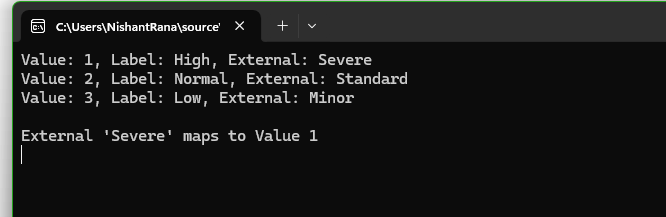
We have Severe, Moderate, and Minor external values specified for High, Normal, and Low choices respectively. These external values could be how the external third-party system is tracking the priority values to which we are integrating.

The external system sends us “priority”:” high” and we map that to the internal value 1 in Dataverse.

While sending data to the external system we convert the internal value to the external code i.e. 1 to. High

Below is how we can read the external values.

     var myServiceClient = new CrmServiceClient(connectionString);     

        if (myServiceClient.IsReady)
        {
            var request = new RetrieveAttributeRequest
            {
                EntityLogicalName = "incident",
                LogicalName = "prioritycode",
                RetrieveAsIfPublished = true
            };

            var response = (RetrieveAttributeResponse)myServiceClient.Execute(request);
            var picklistMetadata = (PicklistAttributeMetadata)response.AttributeMetadata;

            foreach (var option in picklistMetadata.OptionSet.Options)
            {
                Console.WriteLine($"Value: {option.Value}, Label: {option.Label?.UserLocalizedLabel?.Label}, External: {option.ExternalValue}");
            }

            string ext = "Severe";
            var match = picklistMetadata.OptionSet.Options.FirstOrDefault(o => o.ExternalValue == ext);
            if (match != null)
            {
                Console.WriteLine($"\nExternal '{ext}' maps to Value {match.Value}");
            }

        }
A screenshot of a computer

AI-generated content may be incorrect.

Using External values, we can decouple integrations from the internal values that we use for our choice column. By using them, we can speak the language of the external system while still maintaining proper structure and metadata within Dataverse.

Hope it helps..

Advertisements

Updating Records Without Triggering Plugins – Bypassing Plugin Execution in Dynamics 365 / Dataverse using C#


Recently, we had to write a small utility—a console application—that would go and update a bunch of existing records in our Dynamics 365 environment. However, we didn’t want any of my custom plugins to trigger during this update. Because the updates were internal, more like data correction / cleanup, and had nothing to do with business rules or processes enforced via plugins. Triggering them would’ve not only been unnecessary but could also lead to unwanted side effects like auto-assignments, email sends, or data syncing. Thankfully, the Dataverse platform provides us with two powerful properties that allow us to selectively bypass plugin execution logic.

BypassCustomPluginExecution – This allows us to bypass all the plugin steps for an operation – create, update, delete, etc.

BypassBusinessLogicExecutionStepIds – If we do not want to skip all the plugin steps, but just a few specific ones, we can use this property.

We have the below sample plugin registered that throws InvalidPluginExecutionException on the update of the lead record.

A screenshot of a computer

AI-generated content may be incorrect.

On updating the record through the console app, we will get the same exception.

To bypass all the plugins that are registered on Update, we can use the BypassCustomPluginExecution property as shown below.

A screenshot of a computer program

AI-generated content may be incorrect.

To bypass only the specific plugin steps that are registered on Update, we can use the BypassBusinessLogicExecutionStepIds property as shown below.

A computer screen shot of a computer code

AI-generated content may be incorrect.
A screenshot of a computer

AI-generated content may be incorrect.

One point to remember is these flags do not bypass system plugins or platform logic—only custom plugin steps we’ve registered.

This was a really handy trick in our recent utility and helped us to safely update the records without triggering the plugin. The other options could have been to either temporarily deactivate the plugin step, add certain conditions to the plugin based on calling user, flag/fields on the record etc.

Also check – https://nishantrana.me/2023/11/08/use-tag-parameter-to-add-a-shared-variable-to-the-plugin-dataverse-dynamics-365/comment-page-1/

Hope it helps..

Fixed – “Input String Was Not in a Correct Format / The specified domain does not exist or cannot be contacted” in Dataverse Plugin (Dynamics 365)


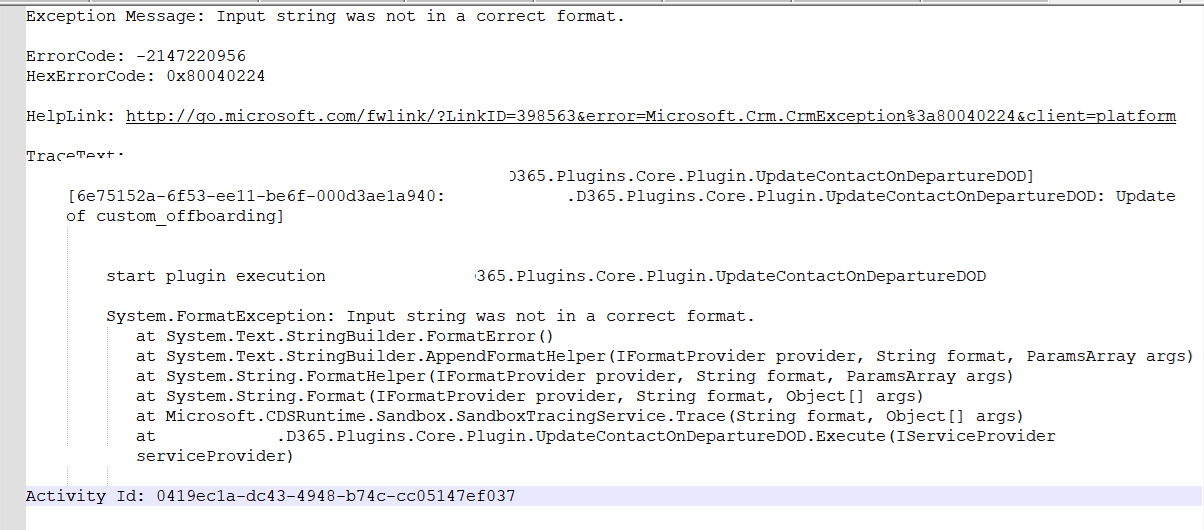
In one of our plugins, we encountered “The specified domain does not exist or cannot be contactedSystem.FormatException: Input string was not in a correct format” error. Basically this issue can arise due to incorrect string formatting, unexpected data types, or missing values.

Our initial thought was that it could be because one of the GUID data type fields was null and being used in the Retrieve method.

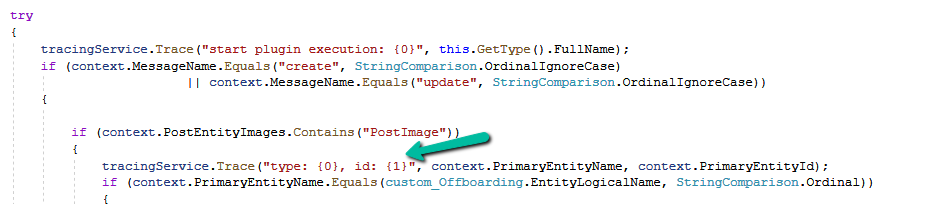
However, it turned out to be because of the following trace statement.

Sample code –

A screen shot of a computer

AI-generated content may be incorrect.

Extra space inside { 1}. The correct syntax is {1} instead of { 1}. We removed the extra space.

A computer code with a green arrow pointing to it

AI-generated content may be incorrect.

This fixed the issue for us.

Hope it helps..

Advertisements

Visualize Data in a View with Copilot (Preview) – Dataverse / Dynamics 365


The copilot-powered data visualization in views feature, currently in preview, allows us to generate quick and insightful charts from Dataverse table views using natural language. We can select a table view and ask Copilot to generate visualizations, making data interpretation easier.

  • Natural Language Queries – Ask Copilot in simple terms to generate relevant charts.
  • Multiple Chart Types – Bar charts, pie charts, line graphs, and more.
  • Instant Insights – No need to build reports; visualize directly from your data view.
  • Interactive Refinements – Modify the chart type or tweak the data selection.

To enable it, for the environment, navigate to Settings >> Features and enable Natural Language Grid and View Search.

We can see the Visualize button added to the views.

A screenshot of a computer

AI-generated content may be incorrect.

It generates the Chart based on the data in the view.

A screenshot of a computer

AI-generated content may be incorrect.

Selecting a particular area filters the data in the view accordingly.

We also have the option to change the chart type, copy the chart, expand the view, etc.

A screenshot of a computer screen

AI-generated content may be incorrect.

We can also use natural language to specify the data or can select AI-generated suggestions for the views.

More on Natural Language Grid and View Search – https://nishantrana.me/2025/02/04/check-out-the-natural-language-grid-and-view-search/

A screenshot of a computer

AI-generated content may be incorrect.

Here we selected/specified the query “Cases where customer is Alpine Ski House” and the Chart and View updated accordingly.

A screenshot of a computer

AI-generated content may be incorrect.

This Copilot-driven data visualization feature is a game-changer for users who need quick insights from their data without setting up complex reports. With just a few clicks and simple queries, Power Apps can now deliver meaningful charts on the fly.

Get more information

Hope it helps..

Advertisements