While working on a LINQ query using early-bound classes in a Dynamics 365 plugin, we encountered a familiar error.
“Could not find an implementation of the query pattern for source type. ‘Where’ not found”
At a glance, everything looked fine. The query was syntactically correct, and the early-bound class was generated properly.
After spending some time, we realized that the error message wasn’t due to the query or the early-bound class itself. It was because we forgot to include the following directive:
using System.Linq;
Without this, C# doesn’t recognize LINQ query methods like Where, Select, or ToList.
Adding this single line at the top of the file resolved the issue immediately, the LINQ query compiled and executed as expected.
Dataverse provides a flexible way to manage data through choice (option set) fields. One of the newer enhancements is the Hidden property, which allows administrators to hide specific choice values from selection while retaining them in the system.
To see it in action,
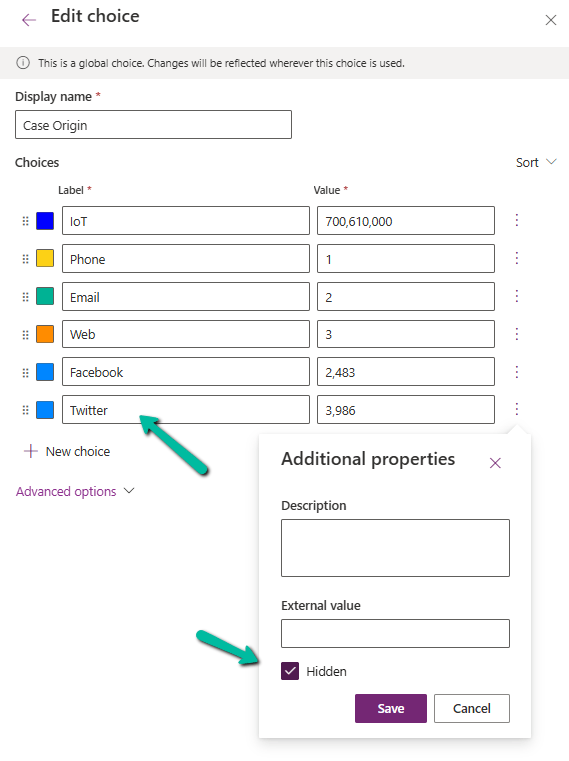
Navigate to Dataverse Table Designer in the Power Apps Maker Portal, and select the Choice (Option Set) field.
Here we have selected the Origin choice field of the Case table.
We have selected the Twitter choice value.
Click on a particular choice value and open Additional Properties, check the Hidden checkbox, and save and publish the changes.
After applying these settings,
Hidden choice values will not appear in dropdown lists when users create or update records.
Existing records with hidden values will still display them in forms and views.
We can see the option greyed out for the record having that existing hidden value.
Business rules and workflows can still reference hidden values.
The hidden choice remains in the metadata and can be retrieved using FetchXML, OData, or SDK queries.
Power Automate flows triggered on record updates will still recognize hidden values.
We can use this new feature for the deprecating values that should no longer be used but still need to exist in historical data. Also, we need to communicate changes to users to prevent confusion when certain values disappear from selection lists. And finally, we should consider data migration and cleanup if a value should never be used again.
Thus, the Hidden property for choice fields in Dataverse provides a powerful way for us to manage choice options dynamically without affecting existing records. By leveraging this feature, we can ensure a smoother transition when phasing out obsolete values while maintaining data integrity.
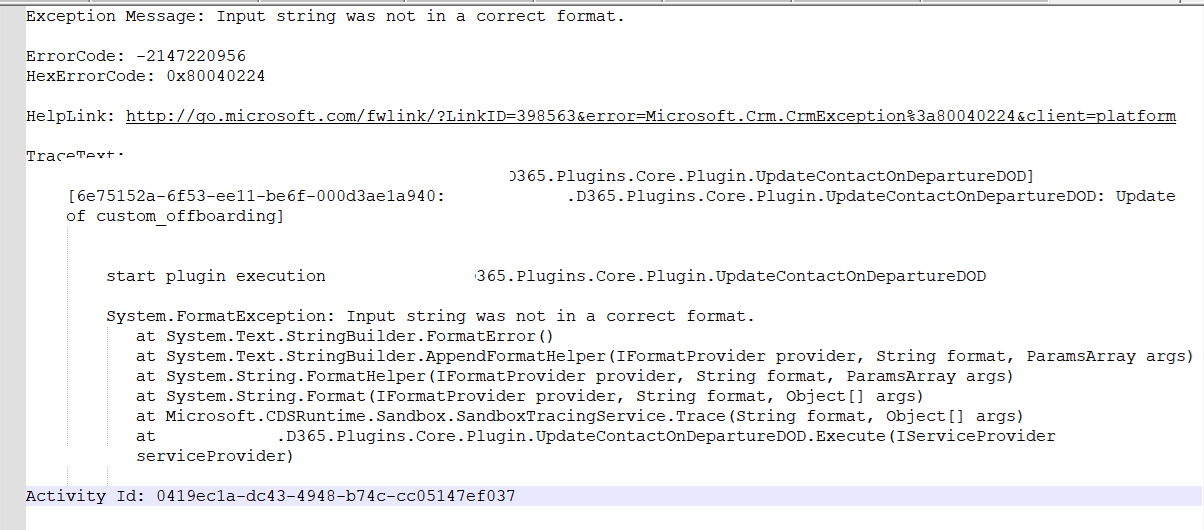
In one of our plugins, we encountered “The specified domain does not exist or cannot be contacted – System.FormatException: Input string was not in a correct format” error. Basically this issue can arise due to incorrect string formatting, unexpected data types, or missing values.
Our initial thought was that it could be because one of the GUID data type fields was null and being used in the Retrieve method.
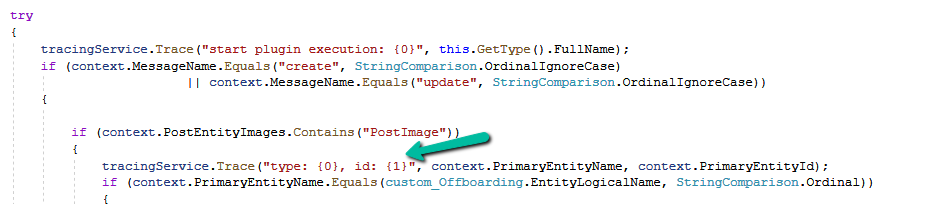
However, it turned out to be because of the following trace statement.
Sample code –
Extra space inside { 1}. The correct syntax is {1} instead of { 1}. We removed the extra space.
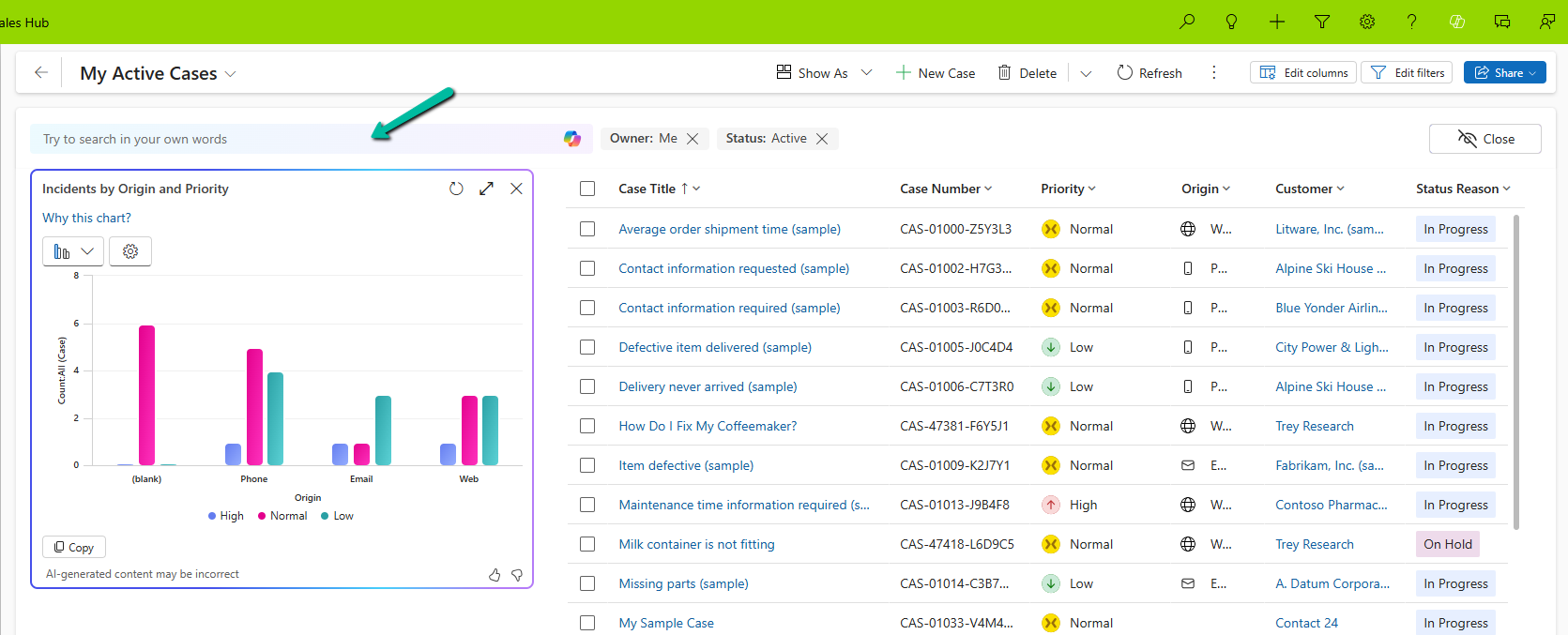
The copilot-powered data visualization in views feature, currently in preview, allows us to generate quick and insightful charts from Dataverse table views using natural language. We can select a table view and ask Copilot to generate visualizations, making data interpretation easier.
Natural Language Queries – Ask Copilot in simple terms to generate relevant charts.
Multiple Chart Types – Bar charts, pie charts, line graphs, and more.
Instant Insights – No need to build reports; visualize directly from your data view.
Interactive Refinements – Modify the chart type or tweak the data selection.
To enable it, for the environment, navigate to Settings >> Features and enable Natural Language Grid and View Search.
We can see the Visualize button added to the views.
It generates the Chart based on the data in the view.
Selecting a particular area filters the data in the view accordingly.
We also have the option to change the chart type, copy the chart, expand the view, etc.
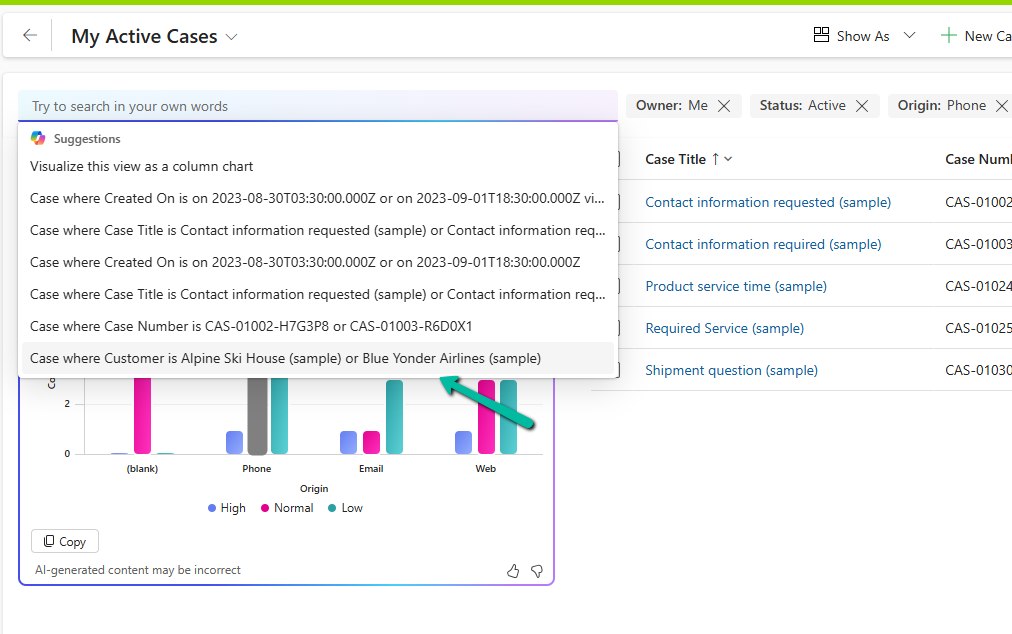
We can also use natural language to specify the data or can select AI-generated suggestions for the views.
Here we selected/specified the query “Cases where customer is Alpine Ski House” and the Chart and View updated accordingly.
This Copilot-driven data visualization feature is a game-changer for users who need quick insights from their data without setting up complex reports. With just a few clicks and simple queries, Power Apps can now deliver meaningful charts on the fly.
Recently we got the below error while trying to assign the record.
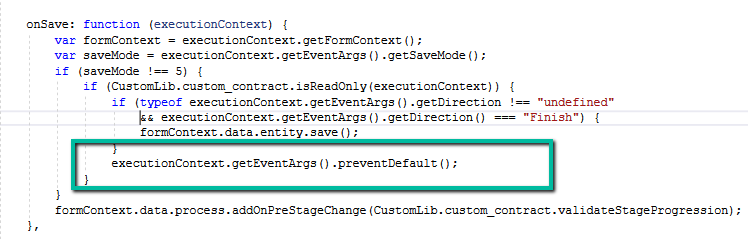
Unable to save. This form can’t be saved due to a custom setting.
Turned out we had certain conditions in the OnSave event for the form, and if the record satisfies those conditions we were canceling the save event using
MultiSelect OptionSet (Choices) fields in Dataverse provide a flexible way to store multiple values within a single field. However, querying and filtering these fields require different techniques depending on the approach used.
In this blog post, we will explore various ways to filter records based on the Skills field (cr1a7_skills), which has the following values:
Name
Value
C#
255780000
Java
255780001
Python
255780002
We have the Skills (choices) field in our Contact table.
The query is to fetch all the contact records where skills includes C# or Java.
Filtering Using FetchXML
FetchXML allows filtering MultiSelect Option Set fields using the contain-values operator.
Using QueryExpression, we can apply the ContainValues condition to filter Multi
var query = new QueryExpression("contact");
query.ColumnSet.AddColumns("fullname");
query.Criteria.AddCondition("cr1a7_skills", ConditionOperator.ContainValues, 255780000, 255780001);
Filtering Using OData (Web API)
OData allows filtering MultiSelect Option Set fields using the ContainValues function.
If you’re using the SQL4CDS tool in XrmToolBox, you can filter MultiSelect Option Set fields using LIKE conditions.
SELECT contactid,
       fullname
FROM   contact
WHERE  statecode = 0
       AND (cr1a7_skills = '255780000'
            OR cr1a7_skills LIKE '255780000,%'
            OR cr1a7_skills LIKE '%,255780000,%'
            OR cr1a7_skills LIKE '%,255780000'
            OR cr1a7_skills = '255780001'
            OR cr1a7_skills LIKE '255780001,%'
            OR cr1a7_skills LIKE '%,255780001,%'
            OR cr1a7_skills LIKE '%,255780001'
            );
Filtering Using LINQ (C#)
For LINQ queries, MultiSelect Option Sets must be processed as OptionSetValueCollection.
        if (myServiceClient.IsReady)
        {
            using (var context = new OrganizationServiceContext(myServiceClient))
            {

                var skillValues = new List<int> { 255780000, 255780001 };

                var allContacts = context.CreateQuery("contact")
                .Where(c => c["cr1a7_skills"] != null &&
                            (int)c["statecode"] == 0)
                .ToList();

                var filteredContacts = allContacts
                    .Where(c => ((OptionSetValueCollection)c["cr1a7_skills"])
                                .Select(osv => osv.Value)
                                .Any(skill => skillValues.Contains(skill)))
                    .Select(c => new
                    {
                        ContactId = c["contactid"],
                        FullName = c.Contains("fullname") ? c["fullname"].ToString() : string.Empty
                    })
                    .ToList();

                var result = filteredContacts;

            }
        }















 Nishant Rana's Weblog