Calling SharePoint Online API using Azure AD App-Only permissions using Certificate Auth


Below are the steps we need to follow to call SharePoint Online API through a Console App (C#).

The first step is to register an Azure AD app.

Provide appropriate SharePoint API Permissions

A screenshot of a computer

Description automatically generated

As the console app would run in the background we opted for Application Permissions.

A screenshot of a computer screen

Description automatically generated

For testing, we opted for Sites.FullControl.All permission.

Also, Grant the admin consent

A screenshot of a computer

Description automatically generated

Next, we need to generate and upload the certificate

Run the below PowerShell script to generate the self-signed certificate

.\Create-SelfSignedCertificate.ps1 -CommonName “MySampleCertificate” -StartDate 2024-01-01 -EndDate 2026-10-01

#Requires -RunAsAdministrator
<#
.SYNOPSIS
Creates a Self Signed Certificate for use in server to server authentication
.DESCRIPTION
.EXAMPLE
.\Create-SelfSignedCertificate.ps1 -CommonName "MyCert" -StartDate 2015-11-21 -EndDate 2017-11-21
This will create a new self signed certificate with the common name "CN=MyCert". During creation you will be asked to provide a password to protect the private key.
.EXAMPLE
.\Create-SelfSignedCertificate.ps1 -CommonName "MyCert" -StartDate 2015-11-21 -EndDate 2017-11-21 -Password (ConvertTo-SecureString -String "MyPassword" -AsPlainText -Force)
This will create a new self signed certificate with the common name "CN=MyCert". The password as specified in the Password parameter will be used to protect the private key
.EXAMPLE
.\Create-SelfSignedCertificate.ps1 -CommonName "MyCert" -StartDate 2015-11-21 -EndDate 2017-11-21 -Force
This will create a new self signed certificate with the common name "CN=MyCert". During creation you will be asked to provide a password to protect the private key. If there is already a certificate with the common name you specified, it will be removed first.
#>
Param(

[Parameter(Mandatory=$true)]
   [string]$CommonName,

[Parameter(Mandatory=$true)]
   [DateTime]$StartDate,

[Parameter(Mandatory=$true)]
   [DateTime]$EndDate,

[Parameter(Mandatory=$false, HelpMessage="Will overwrite existing certificates")]
   [Switch]$Force,

[Parameter(Mandatory=$false)]
   [SecureString]$Password
)

# DO NOT MODIFY BELOW

function CreateSelfSignedCertificate(){

#Remove and existing certificates with the same common name from personal and root stores
    #Need to be very wary of this as could break something
    if($CommonName.ToLower().StartsWith("cn="))
    {
        # Remove CN from common name
        $CommonName = $CommonName.Substring(3)
    }
    $certs = Get-ChildItem -Path Cert:\LocalMachine\my | Where-Object{$_.Subject -eq "CN=$CommonName"}
    if($certs -ne $null -and $certs.Length -gt 0)
    {
        if($Force)
        {

foreach($c in $certs)
            {
                remove-item $c.PSPath
            }
        } else {
            Write-Host -ForegroundColor Red "One or more certificates with the same common name (CN=$CommonName) are already located in the local certificate store. Use -Force to remove them";
            return $false
        }
    }

$name = new-object -com "X509Enrollment.CX500DistinguishedName.1"
    $name.Encode("CN=$CommonName", 0)

$key = new-object -com "X509Enrollment.CX509PrivateKey.1"
    $key.ProviderName = "Microsoft RSA SChannel Cryptographic Provider"
    $key.KeySpec = 1
    $key.Length = 2048
    $key.SecurityDescriptor = "D:PAI(A;;0xd01f01ff;;;SY)(A;;0xd01f01ff;;;BA)(A;;0x80120089;;;NS)"
    $key.MachineContext = 1
    $key.ExportPolicy = 1 # This is required to allow the private key to be exported
    $key.Create()

$serverauthoid = new-object -com "X509Enrollment.CObjectId.1"
    $serverauthoid.InitializeFromValue("1.3.6.1.5.5.7.3.1") # Server Authentication
    $ekuoids = new-object -com "X509Enrollment.CObjectIds.1"
    $ekuoids.add($serverauthoid)
    $ekuext = new-object -com "X509Enrollment.CX509ExtensionEnhancedKeyUsage.1"
    $ekuext.InitializeEncode($ekuoids)

$cert = new-object -com "X509Enrollment.CX509CertificateRequestCertificate.1"
    $cert.InitializeFromPrivateKey(2, $key, "")
    $cert.Subject = $name
    $cert.Issuer = $cert.Subject
    $cert.NotBefore = $StartDate
    $cert.NotAfter = $EndDate
    $cert.X509Extensions.Add($ekuext)
    $cert.Encode()

$enrollment = new-object -com "X509Enrollment.CX509Enrollment.1"
    $enrollment.InitializeFromRequest($cert)
    $certdata = $enrollment.CreateRequest(0)
    $enrollment.InstallResponse(2, $certdata, 0, "")
    return $true
}

function ExportPFXFile()
{
    if($CommonName.ToLower().StartsWith("cn="))
    {
        # Remove CN from common name
        $CommonName = $CommonName.Substring(3)
    }
    if($Password -eq $null)
    {
        $Password = Read-Host -Prompt "Enter Password to protect private key" -AsSecureString
    }
    $cert = Get-ChildItem -Path Cert:\LocalMachine\my | where-object{$_.Subject -eq "CN=$CommonName"}

Export-PfxCertificate -Cert $cert -Password $Password -FilePath "$($CommonName).pfx"
    Export-Certificate -Cert $cert -Type CERT -FilePath "$CommonName.cer"
}

function RemoveCertsFromStore()
{
    # Once the certificates have been been exported we can safely remove them from the store
    if($CommonName.ToLower().StartsWith("cn="))
    {
        # Remove CN from common name
        $CommonName = $CommonName.Substring(3)
    }
    $certs = Get-ChildItem -Path Cert:\LocalMachine\my | Where-Object{$_.Subject -eq "CN=$CommonName"}
    foreach($c in $certs)
    {
        remove-item $c.PSPath
    }
}

if(CreateSelfSignedCertificate)
{
    ExportPFXFile
    RemoveCertsFromStore
}

Specify the password and note it down as it will be used for connection.

Upload the certificate to the Azure AD App registered.

A screenshot of a computer

Description automatically generated

For the console app, we installed the PnP.Framework Nuget Package

A screenshot of a computer

Description automatically generated

The sample code –

           try
            {
                var authManager = new AuthenticationManager(applicationId, certPath, password, domain);
                using (ClientContext clientContext = authManager.GetContext(siteUrl))
                {
                    var folder = clientContext.Web.GetFolderByServerRelativeUrl(folderRelativeUrl);
                    clientContext.Load(folder);
                    clientContext.Load(folder.Files);
                    clientContext.ExecuteQuery();

                    foreach (var file in folder.Files)
                    {
                        if (countFilesToImport < maxFilesPerCycle)
                        {
                            _filesToImport.Add(file);
                        }

                        countFilesToImport++;
                    }
                }
            }
            catch (Exception ex)
            {
                System.Console.WriteLine("Error: " + ex.Message);
                if (ex.InnerException != null)
                {
                    System.Console.WriteLine("Inner Exception: " + ex.InnerException.Message);
                }
            }
        }

We can see our app is successfully connected.

A computer screen shot of a program

Description automatically generated

The other option is to use the SharePoint app-only, which is not recommended by Microsoft.

We can see the following message for it.

Starting April 2, 2026, Azure Access Control service (ACS) usage will be retired for SharePoint in Microsoft 365 and users will no longer be able to create or use Azure ACS principals to access SharePoint. Learn more about the Access Control retirement

A screenshot of a computer

Description automatically generated

Get all the details here

Hope it helps..
Advertisements

Set an app (Model-driven or Canvas App) as a startup app – Power Apps Mobile


Microsoft has introduced a new feature, through which we can now specify a particular app as a start-up app, that will open up when we launch the Power Apps mobile, instead of waiting for the home page / or selecting it from favorites.

Below we can select the option Open at Startup to specify the Customer Service Hub app as the startup app as an example.

A screenshot of a phone

Description automatically generated

Or we can swipe left to mark an app as “Startup App

A screenshot of a phone

Description automatically generated

We can see an icon next to the app.

Now launching the Power Apps mobile app will directly open the Customer Service Hub app.

A screenshot of a phone

Description automatically generated

Using the Remove from startup option we can remove it as the startup app

A screenshot of a phone

Description automatically generated

We can only have one app set as a startup app, if we try setting up another app as a startup we get the notification that it will replace the existing app.

A screenshot of a phone

Description automatically generated

Get all the details here

Hope it helps..
Advertisements

Mobile Offline Profile – Select columns to be downloaded (Dynamics 365 / Model-driven apps)


With this new feature (preview) now we can specify the columns to be downloaded on mobile devices for offline use.

Select edit for the Model-driven app.

A screenshot of a computer

Description automatically generated

Select Settings and select an existing offline profile or create a new profile.

A screenshot of a computer

Description automatically generated

Select a new table or an existing table for the profile, we can see the Manage Columns option for it.

A screenshot of a computer

Description automatically generated

We can see key columns already selected as part of Required Columns.

We can select columns from the other columns section for our offline profile. The fewer the columns the faster the app will download the data for offline usage.

One point to note is that we get this option only from the Maker Portal not from the Power Platform Admin Center.

Hope it helps..
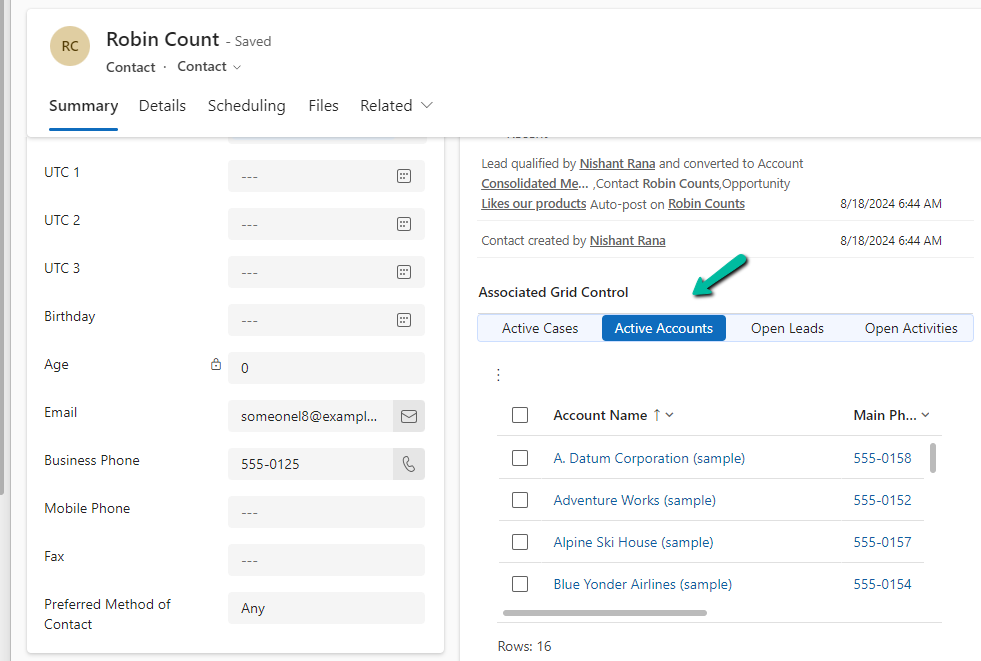
Perform Age calculation using Formula Columns in Dataverse / Dynamics 365


Below we have created a new field of Data Type Formula and Formula Data Type as Whole Number

A screenshot of a computer

Description automatically generated

Specify the following formula.

RoundDown(DateDiff(birthdate, UTCNow(), TimeUnit.Days) / 365.25, 0)

  • DateDiff calculates the difference in days between birthdate and current UTC Date.
  • Dividing by 365.25 takes care of converting the days to years, considering the leap year into account.
  • Roundown takes care of rounding the result to a nearest integer.

Below we see the field in action.

UTC current date is 10th Wednesday July 2024 for the below example.

A screenshot of a computer

Description automatically generated

Also checkout the helpful video –

and the forum – https://powerusers.microsoft.com/t5/Microsoft-Dataverse/Calculating-age-in-CDS-entity/td-p/495528

Hope it helps..
Advertisements

Using Homogenous Batch / Bulk operation messages for improved performance – Data Migration / Dataverse


As we all are aware Microsoft has introduced Bulk Operation messages in the platform. Now we could use the same in our SSIS Package that uses KingswaySoft’s SSIS Integration Toolkit for Microsoft Dynamics 365 by using the Homengeneous Batch Operation Messages option in the CDS / CRM Destination Component Editor.

Let us first use the data spawner component to generate sample data for a custom table for which we just have 2 new custom first name and last name fields created as well as mapped with 100 K records.

A screenshot of a computer

Description automatically generated

Let us first run the Package with batch size = 1000, threads as 20, multiplexing user = 5, and homogeneous batch operation disabled.

Below is the User Multiplexing option in the Connection Manger.

A screenshot of a computer

Description automatically generated

Here we have defined 5 different application users.

A screenshot of a computer

Description automatically generated
A screenshot of a computer

Description automatically generated
A computer screen shot of a number

Description automatically generated

Now let us run the same with the Homogenous Batch Operation option checked.

A screenshot of a computer

Description automatically generated
A computer screen shot of a computer screen

Description automatically generated

Below are the findings with different variations of Batch Size, Threads, Multiplexing Users, Homogenous Batch Operation for the – 100K records – Custom table

Batch Size

Threads

Multiplexing Users

Homogenous Batch Operation

Duration (minutes)

1000

20

5

N

5:48

1000

20

5

Y

1:54

500

20

5

N

4:16

500

20

5

Y

1:29

250

20

5

N

3:58

250

20

5

Y

1:38

100

20

5

N

4:47

100

20

5

Y

1:58

500

50

5

N

4:00

500

50

5

Y

1:24

We can see huge performance improvements while using Bulk Operations (Homogenous batch option) for our custom table, with threads around 20 and multiplexing users as 5. Increasing the number of multiplexing users will provide further performance improvement here.

Now let us run it against the Contact table and this time we take 10K as a sample instead of 100K as a sample.

10K records Contact table

Batch Size

Threads

Multiplexing Users

Homogenous Batch Operation

Duration (minutes)

500

1

1

N

25:26

500

1

1

Y

42:14

100

1

1

N

24:34

100

1

1

Y

36:06

100

5

1

N

21:56

100

5

1

Y

16:45

100

10

1

N

6:59

100

10

1

Y

12:54

100

10

2

N

6:14

100

10

2

Y

11:28

100

10

5

N

3:26

100

10

5

Y

9:36

100

15

5

N

2:56

100

15

5

Y

9:57

100

20

5

N

2:34

100

20

5

Y

10:17(Ran into a server-side throttling error.)

1000

20

5

N

5:30 (Ran into a server-side throttling error.)

1000

20

5

Y

5:02 (Ran into a server-side throttling error.)

500

20

5

N

4:20(Ran into a server-side throttling error.)

500

20

5

Y

2:36 (Ran into a server-side throttling error.)

100

20

1

N

18:00

(Ran into a server-side throttling error.)

100

20

1

Y

11:20

(Ran into a server-side throttling error.)

With the higher Batch size along Threads + Multiplexing users + Homogenous Batch Operation message option, we could get a good performance improvement, however, we can see that we ran into server-side throttling errors on increasing the batch size. So with tables having a higher number of fields/relationships, we need to be more careful than a custom/table with fewer relationships and fields

[CDS Destination] Warning: An exception has occurred while processing the service request, the same request will be attempted again immediately. KingswaySoft.IntegrationToolkit.DynamicsCrm.WebAPI.WebApiServiceException: The underlying connection was closed: A connection that was expected to be kept alive was closed by the server. (Error Type / Reason: KeepAliveFailure, Detailed Message: The underlying connection was closed: A connection that was expected to be kept alive was closed by the server.)

[CDS Destination] Warning: A server side throttling is encountered, the same request will be retried after 5 minutes (as instructed by the returned throttling error message from the server). KingswaySoft.IntegrationToolkit.DynamicsCrm.WebAPI.WebApiServiceException: The remote server returned an error: (429) . (Error Type / Reason: 429, Detailed Message: {“error”:{“code”:”0x80072321″,”message”:”Combined execution time of incoming requests exceeded limit of 1200000 milliseconds over time window of 300 seconds. Decrease number of concurrent requests or reduce the duration of requests and try again later.”}})

A screenshot of a computer

Description automatically generated

More on the Homogenous Batch Operation option – https://www.kingswaysoft.com/blog/2023/11/29/Use-Homogeneous-Batch-Operation-Messages-for-Greater-DataverseCRM-Writing-Performance

Hope it helps..
Fixed – Cannot process request because the process (7340) has exited. (Microsoft Visual Studio) – SQL Server Integration Services (SSIS)


Recently while trying to run an SSIS package from within the SSDT, we started getting the below error. The package had been running without any errors a couple of weeks ago.

A screenshot of a computer

Description automatically generated

We tried most of the options suggested, but nothing worked. So eventually tried the Update. That also didn’t work.

A screenshot of a computer

Description automatically generated

Next, we tried the Repair option.

A screenshot of a computer

Description automatically generated

Finally repairing it worked. I think it could be because we had installed another software that was .NET-based, which might have changed a few of the dependent components.

Hope it helps..

Advertisements

Nishant Rana's Weblog

Everything related to Microsoft .NET Technology

Skip to content ↓