How to – Configure Copilot Row Summary for tables main form – Dataverse / Dynamics 365


We all know how frustrating it can be to dig through records just to find key details. With AI-generated record summaries, users can instantly access important information—saving time, reducing effort, and boosting productivity.

We can now create AI-powered record summaries for any table in Power Apps using a simple, guided prompt builder. We get to choose the fields and details that matter most, ensuring users see the right information briefly. There’s even an online testing option to fine-tune the summary before rolling it out. Once set up, the record summary will be readily available in forms, making information access effortless.

To enable it inside the Power Platform Admin Center, select an environment and navigate to

Environment >> Settings >> Features >> AI insights cards

Inside Maker Portal, select the table, and from the Customizations section select the Row summary option.

A screenshot of a computer

AI-generated content may be incorrect.

In the Prompt box, we can specify the columns we want to include as part of the summary.

We can click on +Add data to do so can type the name of the field after “/

A screenshot of a computer

AI-generated content may be incorrect.
A screenshot of a computer

AI-generated content may be incorrect.

After specifying the fields, we can click on the Test prompt to see the response. And can fine tune it further.

A screenshot of a computer

AI-generated content may be incorrect.

Clicking on Apply to main forms applies to all the main forms for the table.

A screenshot of a computer

AI-generated content may be incorrect.

We can see the icon added next to the main forms.

A screenshot of a computer

AI-generated content may be incorrect.

The Row summary toolbar allows us to show, hide, and edit the summary.

A screenshot of a computer

AI-generated content may be incorrect.

Publish the changes.

Below we can see the summary generated for the Contact’s main forms.

Get more details.

Hope it helps..

Advertisements

“Solution manifest import: FAILURE: Solution patch with version already exists. Updating patch is not supported.” – Power Platform / Dynamics 365


While importing a patch (unmanaged) solution we got the below error –

“Solution ‘abc_Configuration’ failed to import: Solution manifest import: FAILURE: Solution patch with version 1.6.1.1 already exists. Updating patch is not supported.”

A screenshot of a computer

Description automatically generated

This is because Dataverse does not allow updating an existing patch solution with the same version number. Dataverse treats patches as immutable once imported. So if a patch already exists in the target environment, we cannot re-import a patch with the same version. Unlike full solutions, patches cannot be updated or overwritten—they must be uniquely versioned.

To fix this we can increase the Patch Version in our source environment. Here we incremented the patch version (from 1.6.1.1 → 1.6.1.2). Exported the patch again and imported it into the target environment.

Dataverse considers each patch version as unique, so increasing the version allows re-import.

Below we can see the new version of the patch imported replacing the old one.

A screenshot of a computer

Description automatically generated

Hope it helps..

Advertisements

Reduce log storage: Delete audit logs – Power Platform Admin Center


Recently we had to copy our production environment to one of our sandbox environments for some analysis and testing.

But before we copied we made sure we deleted the data/attachments/ logs that are not required to save some storage space.

Get more information – https://nishantrana.me/2024/10/15/free-up-storage-space-activitypointerbase-and-workflowlogbase-dataverse-dynamics-365/

We had around 950 MB of Log data in it.

Below are the steps for deleting the audit logs –

Go to the Power Platform Admin Center, and sign in with the appropriate credentials.

Select the Environment, and select Manage Audit Logs in the Auditing section.

A screenshot of a computer

Description automatically generated

Click on Delete Audit Logs. We will be prompted to filter the logs to delete. Filter options may include:

  • By Table (e.g., logs related to a specific table or entity).
  • Delete logs, by people and systems.
  • Time (e.g., logs older than a specific date).
A screenshot of a calendar

Description automatically generated

Confirm Deletion.

A screenshot of a computer

Description automatically generated

Review the summary of logs to be deleted. Click Delete to proceed. This action is irreversible.

Once the deletion is complete, the audit logs are permanently removed.

The storage won’t reflect it immediately.

A screen shot of a message

Description automatically generated
A screenshot of a computer

Description automatically generated
A screenshot of a computer

Description automatically generated

In our case, after 2 hours we could see log usage reduced to 460 MB from 954 MB.

And almost after 24 hours, we could see it reduced to 5 MB.

A screenshot of a computer

Description automatically generated

Get all the details

Hope it helps..

Advertisements

Customizing Business Process Flows: Stage Validation Using JavaScript (Dynamics 365 / Dataverse)


Business Process Flows (BPF) in Dynamics 365 offer a structured way to guide users through a defined process. However, there are scenarios where progression to the next stage must be validated against specific business rules. In this blog, we see how to implement custom validations on stage progression using JavaScript.

Let us take a simple scenario where a Lead can only progress to the next stage of a BPF if

Lead Quality = Hot and Lead Source = Web

If these conditions are not met, users will receive a notification, and the stage change will be prevented.

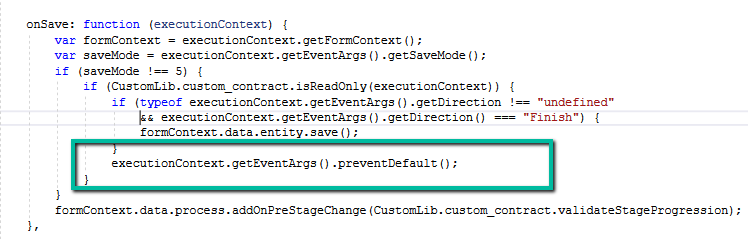
Below is the sample code


function OnLoad(executionContext)
{
 var formContext = executionContext.getFormContext();
 formContext.data.process.addOnPreStageChange(validateStageProgression);
}


function validateStageProgression(executionContext)
{
	    var bpfSampleStage = "6e2b5d9e-da30-4a47-8ca9-d75c24fd51f4";
        var formContext = executionContext.getFormContext();
		var rating = formContext.getControl('header_process_leadqualitycode').getAttribute().getValue();
		var leadSource = formContext.getControl('header_process_leadsourcecode').getAttribute().getValue();
		var stageObj = formContext.data.process.getActiveStage();
        var stageId = stageObj.getId();
		var requiredFieldErrorId = "contractValidationNotificationId";
        formContext.ui.clearFormNotification(requiredFieldErrorId);
		
		if(stageId)
		{
			 if (stageId.toLowerCase() === bpfSampleStage)
			 {
				  if (executionContext.getEventArgs().getDirection() === "Next") 				  
				{
                    executionContext.getEventArgs().preventDefault();
					if(rating == 1 && leadSource == 8) // rating = Hot and Source = Web
					{
						formContext.data.process.removeOnPreStageChange(validateStageProgression);
                        formContext.data.process.moveNext();
					}	
					else
					{
						notificationMessage = "Cannot move to the next stage until conditions are met !";
						formContext.ui.setFormNotification(notificationMessage, "ERROR", requiredFieldErrorId)
					}
				}
			 }
		}
}

The addOnPreStageChange method registers the validation function on the form’s load event to monitor stage changes.

The preventDefault() method stops the stage transition if the conditions are not met, ensuring data integrity.

If the validation fails, an error notification is displayed using the setFormNotification() method, guiding users to correct the data.

Upon satisfying the conditions, moveNext() is invoked programmatically to move the process to the next stage.

As shown below, clicking on Next as rating and lead source values do not satisfy the condition, we can see the notification on the form and the user is not able to move to the next stage.

Also check – https://nishantrana.me/2024/10/09/use-javascript-to-enable-a-field-only-if-the-stage-is-active-in-business-process-flow-dynamics-365-dataverse/

https://nishantrana.me/2024/10/10/use-javascript-to-add-onchange-event-to-a-field-in-the-business-process-flow/

https://nishantrana.me/2024/10/23/javascript-for-fields-in-business-process-flow-few-key-points-dataverse-dynamics-365/

Hope it helps..

Advertisements

Check Out the Natural Language Grid and View search


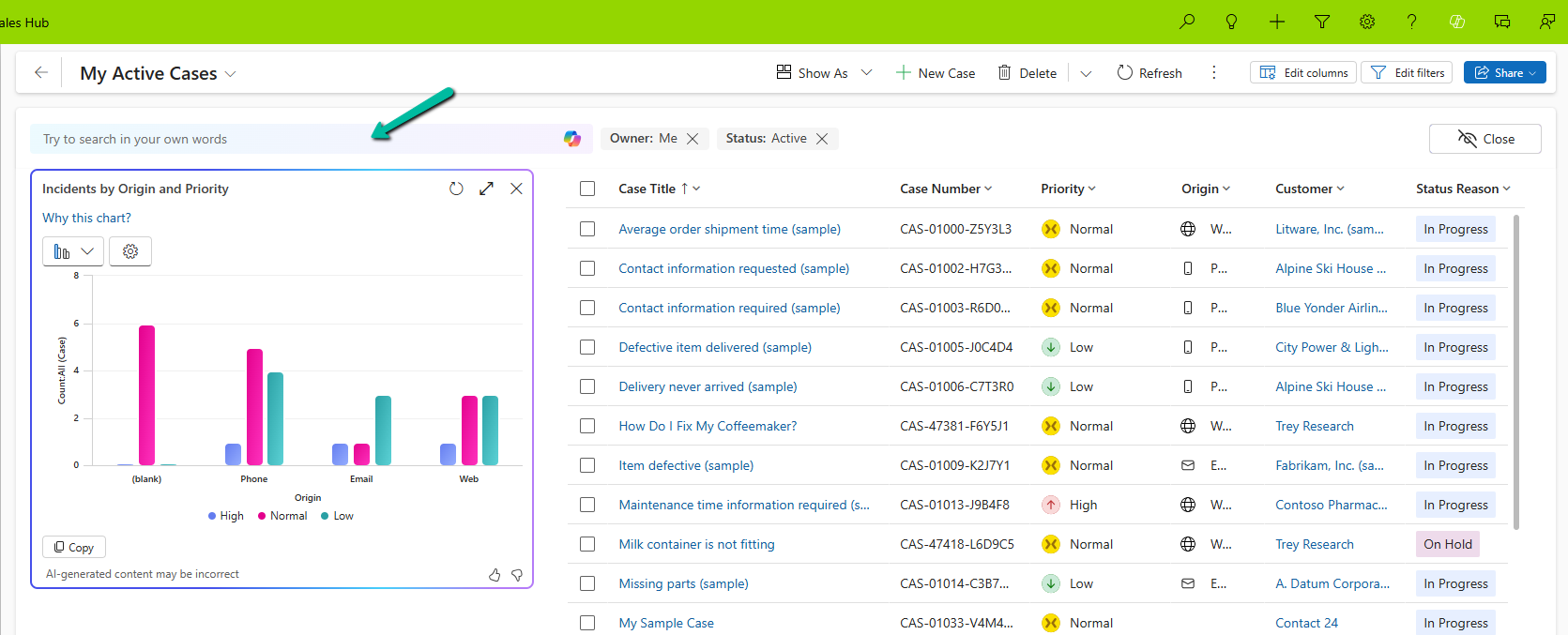
The new Smart Grid Preview feature allows us to find, filter, and sort data with natural language.

To enable it navigate to Environment >> Settings >> Features inside Power Platform Admin Center and turn on Natural Language Grid and View Search.

A screenshot of a computer

Description automatically generated

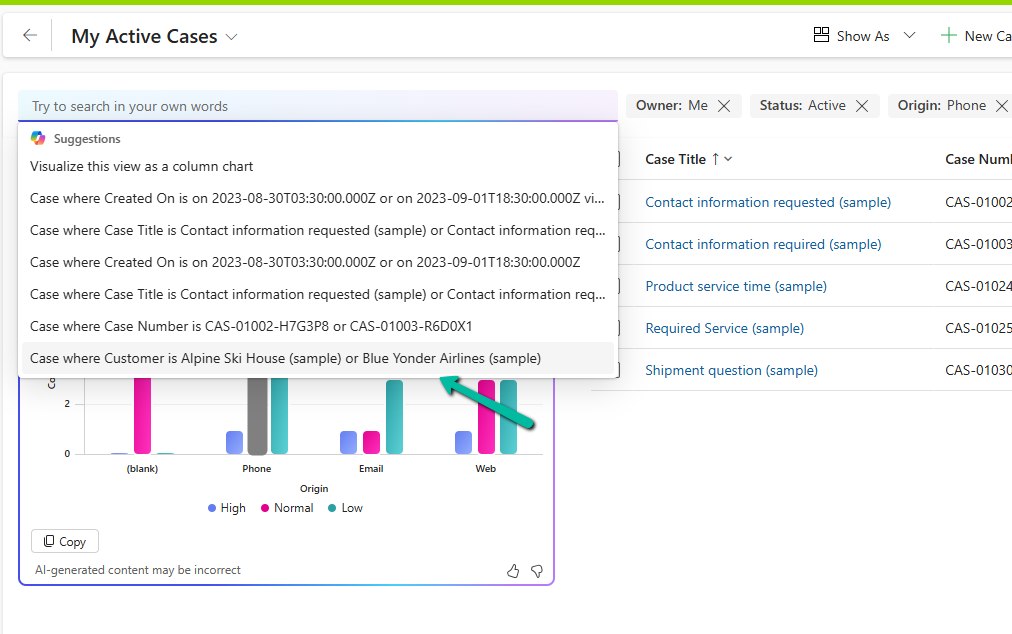
After enabling it we will see a search box on the grid page where we can type in questions about our data in plain English.

A screenshot of a computer

Description automatically generated

Let’s say we need to find “Contacts from the company Contoso”. Normally, this would mean defining the filters/query. But with the Smart Grid’s natural language search, we just type the request, and the system filters the view accordingly.

A screenshot of a computer

Description automatically generated

The result –

A screenshot of a computer

Description automatically generated

We can also use it to sort data.

A screenshot of a computer

Description automatically generated

Another example

A screenshot of a computer

Description automatically generated

The result –

A screenshot of a computer

Description automatically generated

Using natural language search has loads of benefits:

  • Ease of Use: Do complex searches without needing to be tech-savvy.
  • Speed: Find what you need quickly without navigating through multiple filters.
  • Accessibility: Makes data interaction easy for everyone, even if you’re not a tech pro.

As it’s still in preview, there are a few things the Smart Grid Preview doesn’t support yet:

  • Query Aggregation
  • Query Grouping
  • Adding Columns

Remember, it’s still a work in progress and not ready for full production use.

Get more details here

Hope it helps ..

Advertisements

Fixed – The method ‘GroupJoin’ cannot follow the method ‘SelectMany’ or is not supported while using LINQ query (Dataverse / Dynamics 365)


We might get the below error while using LINQ to query Dataverse –

System.NotSupportedException: ‘The method ‘GroupJoin’ cannot follow the method ‘SelectMany’ or is not supported. Try writing the query in terms of supported methods or call the ‘AsEnumerable’ or ‘ToList’ method before calling unsupported methods.’

A screenshot of a computer

Description automatically generated

This error occurs because the GroupJoin method, which is essentially what happens during the into … syntax in LINQ, is not supported in the Dataverse/LINQ provider for Dynamics CRM. The issue is related to how the LINQ provider translates queries into FetchXML or SQL that the Dataverse understands. Specifically, nested joins or SelectMany (used by DefaultIfEmpty() in left joins) are not fully supported by the LINQ provider for Dataverse.

The GroupJoin and DefaultIfEmpty methods (used for left joins) result in queries that cannot be translated directly into FetchXML. The LINQ provider for Dataverse does not support all LINQ-to-Entities features, such as nested joins or advanced grouping logic. When you perform nested joins with DefaultIfEmpty() for left joins, the LINQ provider struggles to translate it into the underlying Dataverse query format, which is why the exception is thrown.

To fix it we can break the query into multiple steps as shown below.

A screenshot of a computer

Description automatically generated

However, here as we are fetching partial data into memory and combining it, it increases transfer and processing overhead and can take a long time to process based on the number of records.

The better alternative from a performance perspective would be to use FetchXML or QueryExpression here.

Also check writing complex LINQ queries

Hope it helps..

Advertisements