Navigation Tour dialog box opens up when user sign in to CRM.
If we want to disable this,
Go to Administration à System Setting à General Tab
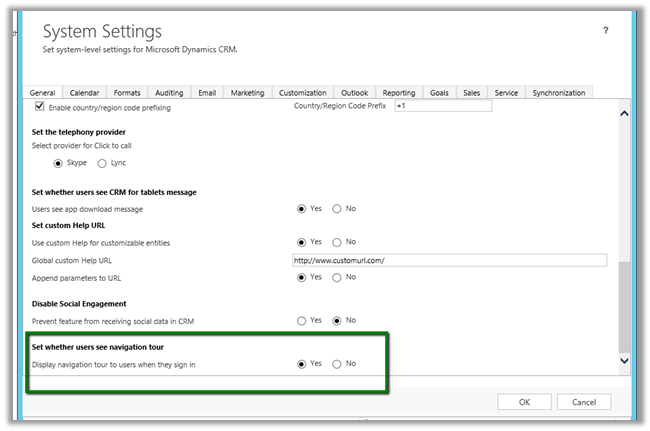

Navigation Tour dialog box opens up when user sign in to CRM.
If we want to disable this,
Go to Administration à System Setting à General Tab

Multi Entity Search
CRM 2015 have added option for multi entity
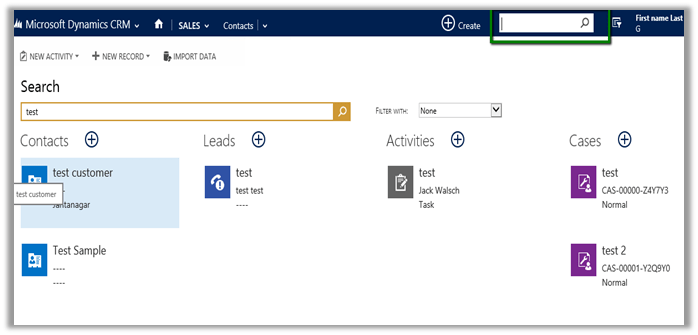
With Maximum 10 entities at a time (can also be used for filtering the result)
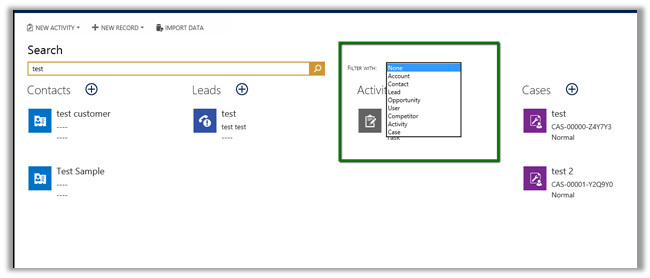
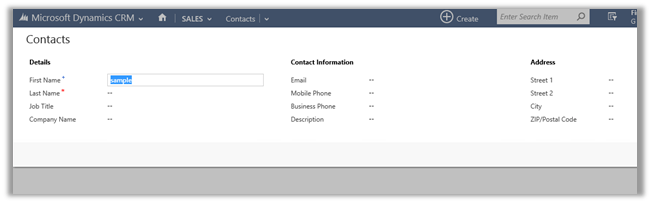
Clicking on “+” in the result opens the quick create form for that record
To set up Quick Find search, Go to à Adminsitration à System Settings
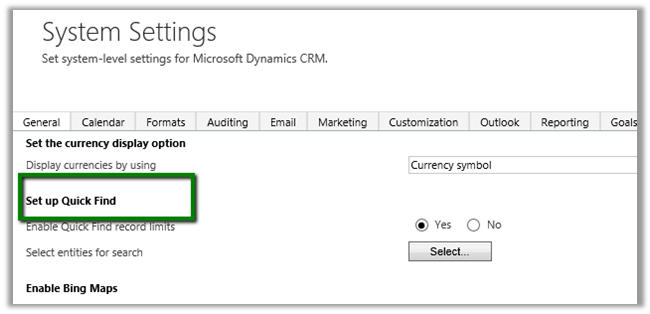
Click on Select to select the entity and specify the order for them.
Maximum of 10 entities can be added for search. (Supports custom entities)
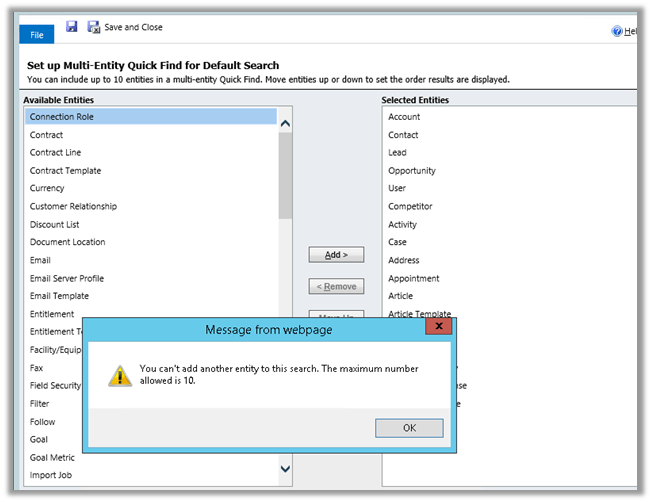
The Search is based on Quick Find View of the respective entity. i.e. based on Find Columns defined in it.
The result displays first 4 column of the Quick Find View.


Add the Site to Compatibility View Setting to get the page working properly in IE 11.


Let us take a simple example
There is a field say “Test Field” and 2 option set fields.
OptionSet1 è A1, A2, A3, A4
OptionSet2èB1, B2, B3, B4
Now the logic that we have to implement is
Show “Test Field” when
OptionSet1 = A1 and OptionSet2= B1
Or
OptionSet1 = A2 and OptionSet2= B2
Else
Field should be hidden
Logic in JavaScript
If (optionset1 == A1 && optionset2== B1)
Show field “Test Field”
Else if (optionset1 == A2 && optionset2== B2)
Show field “Test Field”
Else
Hide field “Test Field”
Logic in Business Rule
To implement the same in business we need write 6 business rules.
Well the good news is that we now have “Else If” condition in CRM 2015.
https://nishantrana.me/2014/10/04/business-rules-in-crm-2015/

Often we have requirement to read option set Text/Value quickly, I wrote a script to quickly read all option sets on a form
Go to Google chrome console(Press F12 in Chrome), select the option Console as per screen, Note that contentIframe0 is selected :

and run following script on your form :
var attributes = Xrm.Page.data.entity.attributes.get();
var optionSetAttributes = ”;
var optionSetValues = ”;
Xrm.Page.ui.controls.forEach(function (control, index) {
if (control.getControlType() == ‘optionset’) {
optionSetValues = ”;
var controlName = “#” + control.getName() + “_i”;
optionSetValues += control.getName() + ” option set values below: nn”;
$(controlName).find(‘option’).first().nextAll().each
(function () {
optionSetValues += ‘<div>’ + ‘Value: ‘ + $(this).attr(‘value’) + ‘,Title: ‘ + $(this).attr(‘title’) + ‘</div>’;
}
);
}
optionSetAttributes += ‘<div>’ + optionSetValues + ‘</div>’;
});
var htmlString = ‘<div style= “overflow:always”>’ + optionSetAttributes + ‘</div>’;
$(“#processControlCollapsibleArea”).after(htmlString);
var w = window.open(“Surprise”, “#”);
var d = w.document.open();
d.write(htmlString);
d.close();
You will get following…
View original post 13 more words


 Nishant Rana's Weblog