Using Form fill Assist Toolbar to streamline data entry in Power Apps


We tried the AI Form Filling Assistance feature in model-driven Power Apps and found it very helpful. One part that we liked the most was the toolbar and file (preview). This makes it much easier to fill forms using information from uploaded documents.

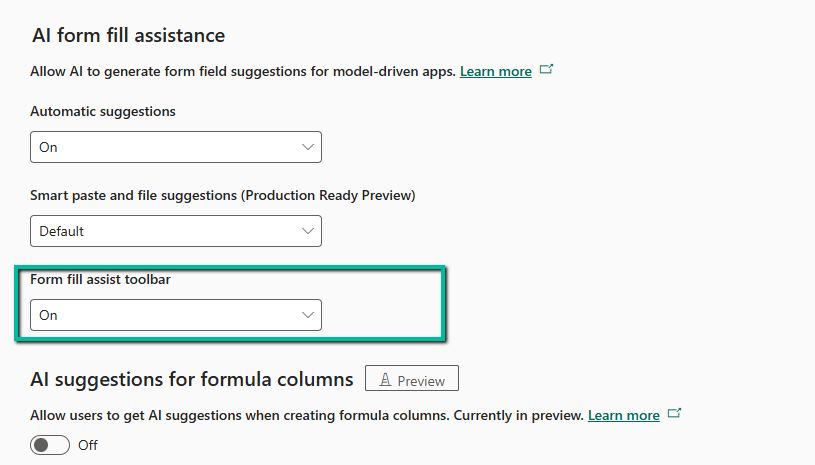
To enable this feature, go to:

Environment → Settings → Features → Form fill assist toolbar (AI Form Fill Assistance)

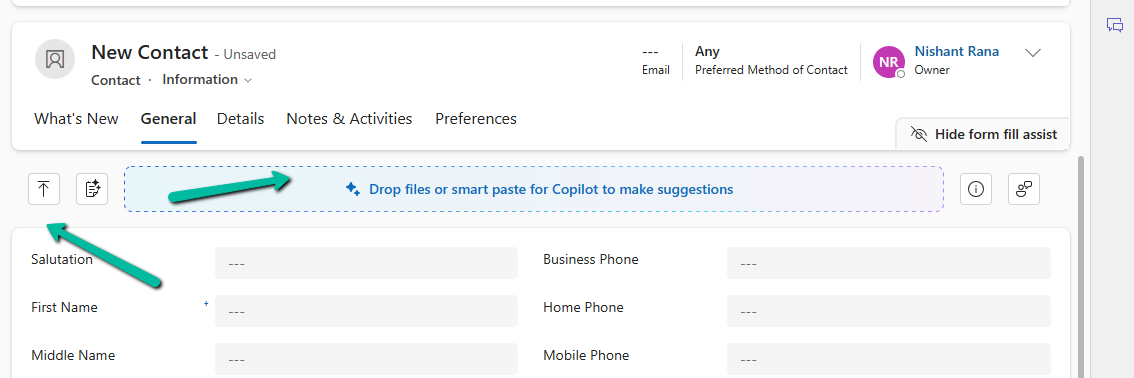
Once enabled, we can simply upload or drag and drop a file — like a PDF, Word document, or image — and the assistant will read the file and suggest values for different form fields.

A screenshot of a computer

AI-generated content may be incorrect.

When we upload / drop a file like a PDF, Word, or image, the assistant reads the file and gives us suggestions to fill the form.

A screenshot of a computer

AI-generated content may be incorrect.

For example, if we upload the following file:

A close-up of a foreign passport

AI-generated content may be incorrect.

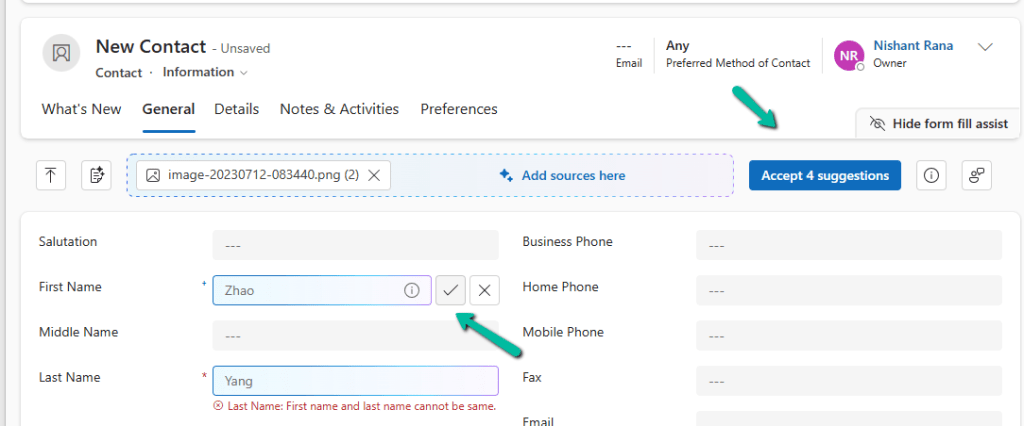
We can see that the assistant picks up values like First Name, Last Name, City, and Country, and populates them into our contact record.

Either we can accept all the suggestions using the Accept suggestions button on the tool bar or can select the suggested value for the individual fields by clicking yes next to it.

The assistant works at the tab level. For example, if we switch to the Details tab and upload the same image again, we might see fields like Birthday get populated — depending on what data is available and which fields are present in that tab.

The different file types supported are – .txt, .docx, .csv, .pdf, .png, .jpg, .jpeg, .bmp.

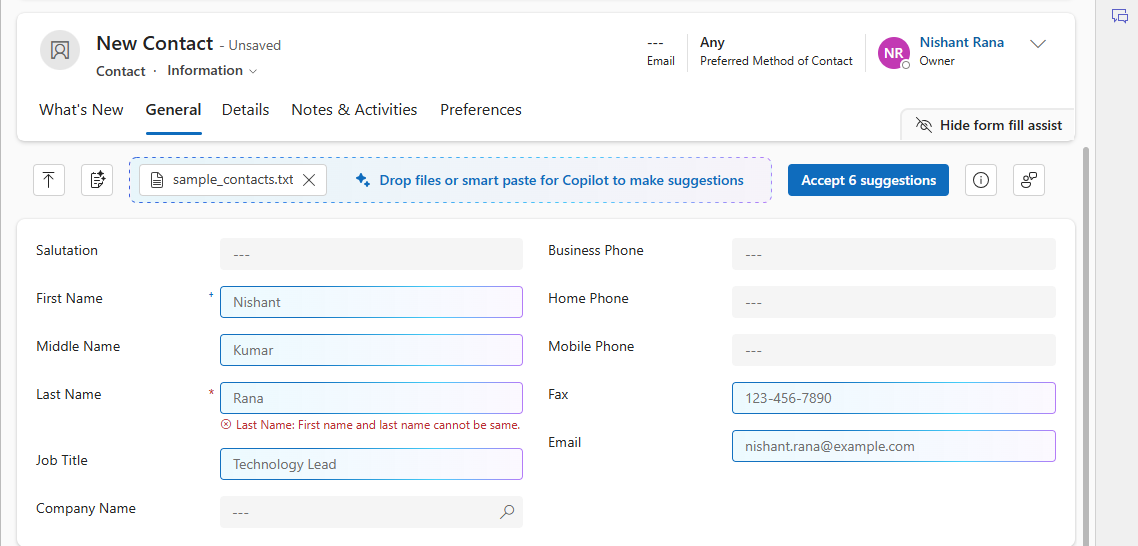
Let us now try uploading the below text file.

A screenshot of a computer

AI-generated content may be incorrect.

We can see it picking the first record and populating the details on the form.

A screenshot of a computer

AI-generated content may be incorrect.

This makes it simple and fast to enter data — especially when we are working with leads, contacts, or records that are usually based on data from documents or scanned forms.

Get more information

Hope it helps..

Advertisements

How We Reclaimed Storage from the WebResourceBase Table in Dataverse


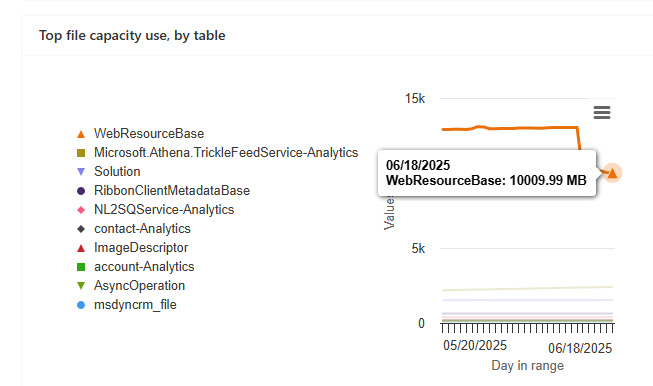
While reviewing our Dataverse environment’s storage usage, we noticed something surprising—over 13 GB of our file capacity was being consumed by the WebResourceBase table alone. This table typically stores JavaScript files, HTML web resources, images, and other files tied to customizations in Dynamics 365. However, the volume was unexpectedly high, prompting us to investigate further.

We started by examining the capacity usage charts available under:

Power Platform Admin Center > Resources > Capacity > File Usage

It was evident that the WebResourceBase table was consistently occupying around 13,027 MB (13 GB), far more than any other table.

Realizing that this wasn’t just normal customization data, we raised a support request with Microsoft to understand what was happening behind the scenes.

After a quick investigation, Microsoft Support responded with the following:

“Upon review, we have found that the WebResourceBase table is indeed occupying a significant amount of storage—13.027 GB. There are instances of ‘orphaned’ WebResourceBase records, which can occur due to solution uninstalls or as leftover artifacts from other entities that depend on WebResources. To address this issue, we can run a script to remove these orphaned web resources, which will help in reducing the storage used in your environment.”

These “orphaned” records are essentially detached or unused web resources—files that are no longer tied to any solution or customization but remain in storage. They commonly appear in environments where unmanaged solutions are frequently installed and removed.

Upon our approval, Microsoft executed a backend script to safely identify and remove these orphaned entries.

Post-Cleanup Results –

Before: 13,027 MB

After: 10009MB

Recovered: 3,018 MB (~3 GB)

A screenshot of a computer

AI-generated content may be incorrect.

This led to around a 24 percent reduction in the file capacity used by the WebResourceBase table.

Microsoft also confirmed that no further reduction was possible at this time—the remaining content is either actively referenced or structurally required by the platform.

Hope it helps..

Advertisements

Handling Unexpected Lookup Auto-Population in Quick Create Forms (Dynamics 365)


Recently, we had a requirement to track the Current and Previous contracts for a Contact in our Dataverse environment. To achieve this, we created two separate N:1 relationships between the Contact and Contract tables

  • custom_currentcontractid → Contact’s Current Contract
  • custom_previouscontractid → Contact’s Previous Contract

So far, so good.

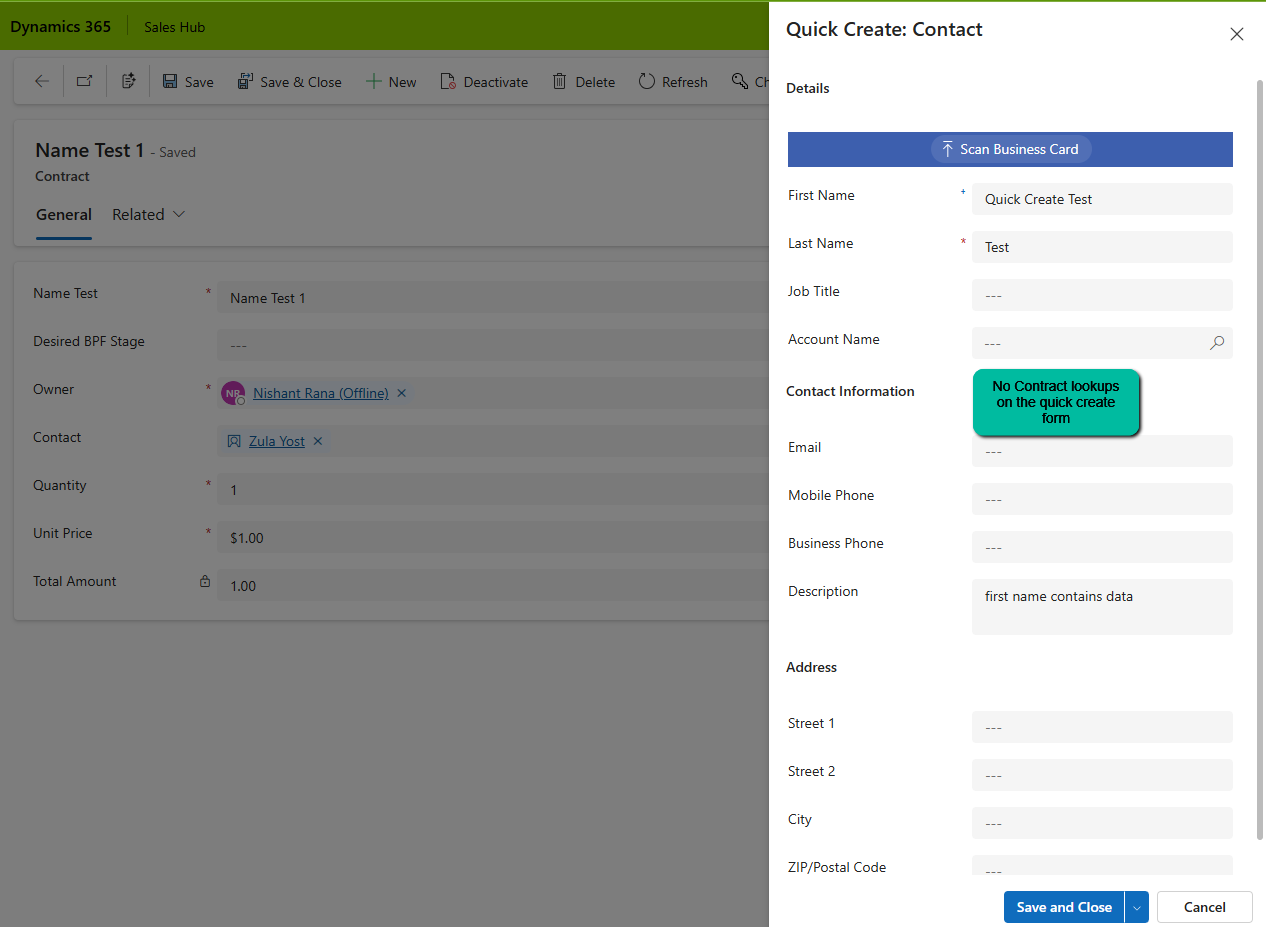
Soon after, we noticed a strange issue: “When creating a Contact from a Contract record (via the Quick Create form), both Current Contract and Previous Contract fields were being automatically populated — with the same Contract record”. This was unexpected, especially since neither field was present on the Quick Create form!

A screenshot of a computer

AI-generated content may be incorrect.

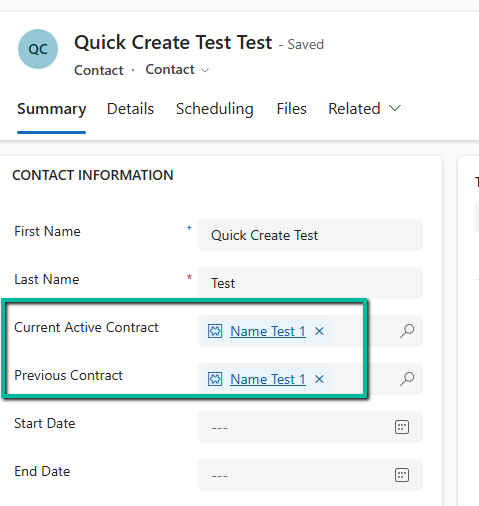
After saving and closing, when we open the record, we can see both the lookup auto-populated with the contract record in context.

A screenshot of a test

AI-generated content may be incorrect.

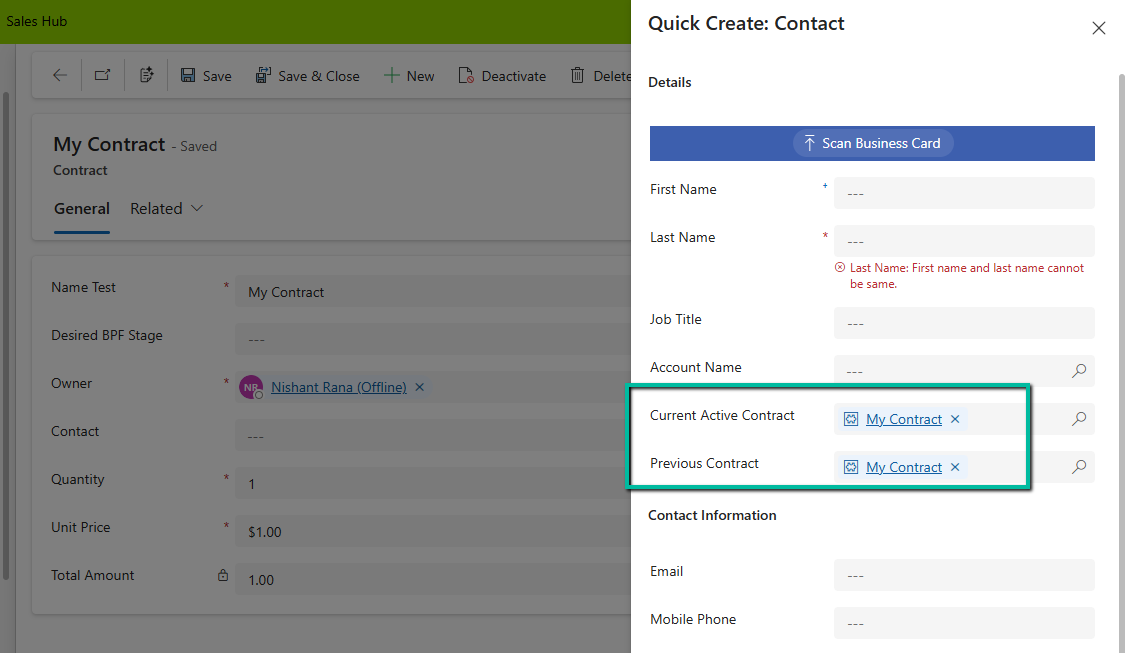
On adding these lookups in the Quick Create form, we can see that Dataverse is auto-populating it with the contract in context.

A screenshot of a contact page

AI-generated content may be incorrect.

When we open a Quick Create form from a record (in our case, from a Contract), Dataverse passes the entity reference context to the Quick Create form. And here’s the catch, If the target entity (Contact) has multiple lookups to the source entity (Contract), Dataverse tries to populate them all.

This behavior is based on relationship metadata, not on what’s visible on the form. So even though we didn’t include the Current Active Contract or Previous Contract on the Quick Create form, Dataverse filled both with the same value.

If we have the fields on the quick create form we can make use of JavaScript on the onload to clear the values.

function clearBothContractLookups(executionContext) {
    var formContext = executionContext.getFormContext();
    
    // Check if in Quick Create mode (formType = 1)
    if (formContext.ui.getFormType() === 1) { 
        var parentRecord = formContext.data.entity.getEntityReference();
        
        // If opened from a Contact, clear BOTH lookups
        if (parentRecord && parentRecord.entityType === "contact") {
            // Clear Current Contract
            if (formContext.getAttribute("new_currentcontract")) {
                formContext.getAttribute("new_currentcontract").setValue(null);
            }
            
            // Clear Previous Contract
            if (formContext.getAttribute("new_previouscontract")) {
                formContext.getAttribute("new_previouscontract").setValue(null);
            }
        }
    }
}

However, like in our case as we did not have these fields on the quick create form, and we didn’t want to have these populated during the creation of the Contract, as these fields were supposed to be populated later, we wrote a Pre-Create Plugin on Pre Operation for it.

public class ClearBothContractLookups : IPlugin
{
    public void Execute(IServiceProvider serviceProvider)
    {
        IPluginExecutionContext context = (IPluginExecutionContext)serviceProvider.GetService(typeof(IPluginExecutionContext));
        
        if (context.InputParameters.Contains("Target") && context.InputParameters["Target"] is Entity)
        {
            Entity contact = (Entity)context.InputParameters["Target"];
            
               // Clear BOTH fields if they exist
                if (contact.Contains("new_currentcontract"))
                    contact["new_currentcontract"] = null;
                
                if (contact.Contains("new_previouscontract"))
                    contact["new_previouscontract"] = null;

              // or remove them from the input parameters 
                  contact.Attributes.Remove("new_currentcontract");
                  contact.Attributes.Remove("new_previouscontract");

            }
        }
    }
}

Hope it helps..

Advertisements

Compare Plugin Steps and Images Across Environments in Dynamics 365


Recently, while testing in UAT, we ran into a plugin-related issue that wasn’t reproducible in Dev. After investigating, we discovered the root cause: one of the plugin step images was missing an attribute in UAT. This wasn’t immediately obvious and not something we’d catch in a standard deployment check. Manually inspecting each plugin step image across environments would be tedious and error-prone. So, we wrote a quick comparison utility using the Dataverse SDK (C#) to help automate this process. Within the tool, we need to specify the schema name of the table. The tool finds all related the sdkmessageprocessingstepimage records, joins them with associated plugin steps (sdkmessageprocessingstep), and then compares the step, image, and the included attributes.

The result –

We can see it listing a missing plugin registration step in UAT and a mismatch in one of the attributes in a step’s image.

The sample code –

 static void Main(string[] args)
        {
            string devConnectionString = "AuthType=OAuth;Url=https://abcdev.crm6.dynamics.com/;Username=abd@xyz.com;AppId=51f81489-12ee-4a9e-aaae-a2591f45987d;LoginPrompt=Auto;RedirectUri=app://58145b91-0c36-4500-8554-080854f2ac97";
            string uatConnectionString = "AuthType=OAuth;Url=https://abcuat.crm6.dynamics.com/;Username=abd@xyz.com;AppId=51f81489-12ee-4a9e-aaae-a2591f45987d;LoginPrompt=Auto;RedirectUri=app://58145b91-0c36-4500-8554-080854f2ac97";
            var devService = new CrmServiceClient(devConnectionString);
            var uatService = new CrmServiceClient(uatConnectionString);
            string entityLogicalName = "custom_contract";
            var devDetails = GetPluginStepImages(devService, GetEntityTypeCode(devService, entityLogicalName));
            var uatDetails = GetPluginStepImages(uatService, GetEntityTypeCode(uatService, entityLogicalName));
            CompareStepsAndImages(devDetails, uatDetails);
            Console.ReadLine();
        }

        static int GetEntityTypeCode(IOrganizationService service, string entityLogicalName)
        {
            var query = new QueryExpression("entity")
            {
                ColumnSet = new ColumnSet("objecttypecode", "logicalname"),
                Criteria = new FilterExpression(LogicalOperator.And)
            };
            query.Criteria.AddCondition("logicalname", ConditionOperator.Equal, entityLogicalName);
            var response = service.RetrieveMultiple(query);
            var entity = response.Entities.FirstOrDefault();
            return (int)entity.Attributes["objecttypecode"];
        }


        static EntityCollection GetPluginStepImages(IOrganizationService service, int objectTypeCode)
        {
            var query = new QueryExpression("sdkmessageprocessingstepimage")
            {
                ColumnSet = new ColumnSet("name", "imagetype", "messagepropertyname", "entityalias", "attributes", "sdkmessageprocessingstepid")
            };

            // Link to sdkmessageprocessingstep
            var stepLink = query.AddLink("sdkmessageprocessingstep", "sdkmessageprocessingstepid", "sdkmessageprocessingstepid");
            stepLink.Columns = new ColumnSet("name", "sdkmessagefilterid");
            stepLink.EntityAlias = "step";

            // Link to sdkmessagefilter
            var filterLink = stepLink.AddLink("sdkmessagefilter", "sdkmessagefilterid", "sdkmessagefilterid");
            filterLink.LinkCriteria.AddCondition("primaryobjecttypecode", ConditionOperator.Equal, objectTypeCode);

            return service.RetrieveMultiple(query);
        }

        static void CompareStepsAndImages(EntityCollection devStepsWithImages, EntityCollection uatStepsWithImages)
        {
            Console.WriteLine("Comparing Plugin Step / Images between Dev and UAT...");

            // Create dictionaries for faster lookup
            var devDict = devStepsWithImages.Entities.GroupBy(e =>
            {
                var stepId = e.GetAttributeValue<EntityReference>("sdkmessageprocessingstepid")?.Id ?? Guid.Empty;
                return stepId;
            }).ToDictionary(g => g.Key, g => g.ToList());

            var uatDict = uatStepsWithImages.Entities.GroupBy(e =>
            {
                var stepId = e.GetAttributeValue<EntityReference>("sdkmessageprocessingstepid")?.Id ?? Guid.Empty;
                return stepId;
            }).ToDictionary(g => g.Key, g => g.ToList());

            foreach (var devStep in devDict)
            {
                var stepId = devStep.Key;
                var devImages = devStep.Value;
                var devStepName = devImages.FirstOrDefault()?.GetAttributeValue<AliasedValue>("step.name")?.Value?.ToString() ?? "(unknown)";

                if (!uatDict.TryGetValue(stepId, out var uatImages))
                {
                    Console.WriteLine($"[MISSING STEP in UAT] Step: {devStepName}, StepId: {stepId}");
                    continue;
                }

                foreach (var devImage in devImages)
                {
                    var devImageName = devImage.GetAttributeValue<string>("name");
                    var devAttrs = devImage.GetAttributeValue<string>("attributes") ?? "";
                    var devType = devImage.GetAttributeValue<OptionSetValue>("imagetype")?.Value;

                    var match = uatImages.FirstOrDefault(u =>
                        u.GetAttributeValue<string>("name") == devImageName);

                    if (match == null)
                    {
                        Console.WriteLine($"[MISSING IMAGE in UAT] Image: {devImageName}, Step: {devStepName}, StepId: {stepId}");
                        continue;
                    }

                    var uatAttrs = match.GetAttributeValue<string>("attributes") ?? "";
                    var uatType = match.GetAttributeValue<OptionSetValue>("imagetype")?.Value;

                    if (devAttrs != uatAttrs || devType != uatType)
                    {
                        Console.WriteLine($"[MISMATCH] Image: {devImageName}, Step: {devStepName}, StepId: {stepId}");
                        Console.WriteLine($"  Dev Attributes: {devAttrs}");
                        Console.WriteLine($"  UAT Attributes: {uatAttrs}");
                        Console.WriteLine($"  Dev ImageType: {ImageTypeToString(devType)}");
                        Console.WriteLine($"  UAT ImageType: {ImageTypeToString(uatType)}");
                    }
                }
            }

            Console.WriteLine("Comparison complete.");
        }

        static string ImageTypeToString(int? type)
        {
            switch (type)
            {
                case 0:
                    return "PreImage";
                case 1:
                    return "PostImage";
                case 2:
                    return "Both";
                default:
                    return "Unknown";
            }
        }

Hope it helps..

Advertisements

Update Business Process Flow Stage using Excel Import with Power Automate – Dataverse / Dynamics 365


In some business scenarios, we might need to update the Business Process Flow (BPF) stage of a record during an Excel import — especially during data migration or bulk record manipulation. In this blog post, we’ll walk through how to set a desired BPF stage (based on the stage name) and automatically move the record to that stage using Power Automate.

We’re working with a custom Dataverse table called Test(cr1a7_test) and a Business Process Flow named My Business Process Flow, which includes the following stages:

“select processidname,stagename, processstageid from processstage where processid = [processGUID]”

A screenshot of a computer

AI-generated content may be incorrect.

Our goal is to allow users to specify the stage name (e.g., “Stage 2”) through Excel import, and have a Power Automate flow update the record’s BPF instance to the corresponding stage automatically.

For this –

  • We’ll add a field called the Desired BPF Stage choice field on our table to store the desired stage name.
  • We’ll create a Power Automate flow that triggers on create or update.
  • We’ll maintain a static JSON mapping of stage names to stage IDs and their traversed paths.
  • We’ll look up the corresponding stage ID and traversed path from the JSON.
  • We’ll fetch the BPF instance for the record.
  • We’ll update the BPF instance with the new active stage and traversed path.

Below is how we can define our JSON structure for mapping, which we will store either in a variable inside Power Automate or save as an environment variable.

A computer code on a white background

AI-generated content may be incorrect.

Trigger – When a row is added or modified.

A screenshot of a computer

AI-generated content may be incorrect.

Initialize Variable with JSON mapping

A screenshot of a computer

AI-generated content may be incorrect.

Parse JSON – using the sample data

A screenshot of a computer

AI-generated content may be incorrect.

Use a “Filter array” action to find the object where stageName matches custom_desiredbpfstage.

A screenshot of a computer

AI-generated content may be incorrect.

Initialize variables to store the Stage ID and traversed path.

  • first(body(‘Filter_array’))?[‘stageId’]
  • first(body(‘Filter_array’))?[‘traversedPath’]
A screenshot of a computer

AI-generated content may be incorrect.

Use List Rows to check if BPF Instance exists or not, if not we will create it or update it.

  • length(outputs(‘List_rows’)?[‘body/value’]) > 0
A screenshot of a computer

AI-generated content may be incorrect.

Update or Create a new BPF instance associated with the record.

A screenshot of a computer

AI-generated content may be incorrect.

Below we can see the user specifying the Stage 3 value for the Desired BPF Stage column in the Excel to be imported.

A screenshot of a computer

AI-generated content may be incorrect.

We can see the Excel imported successfully.

A screenshot of a computer

AI-generated content may be incorrect.

Below we can see our flow running successfully.

A screenshot of a computer

AI-generated content may be incorrect.

And the record in Stage 3 of the BPF.

A screenshot of a computer

AI-generated content may be incorrect.

Hope it helps..

Advertisements

Fixed – The Default Unit is not a member of the specified Unit Group error in Dynamics 365 / Dataverse


Recently while trying to import the product records in our Dynamics 365 Sales, we got the below error – “The Default Unit is not a member of the specified Unit Group”

We were providing the correct UoM Group and Default UoM in our Excel file to be imported.

A screenshot of a computer

AI-generated content may be incorrect.

After some troubleshooting, we realized that we had 2 units with the same name “Primary Unit”, because of which the system was not able to identify the correct unit to be used during the import.

A screenshot of a computer

AI-generated content may be incorrect.

To fix this issue, we replaced the Name with the Guid of the record in our excel file.

A screenshot of a computer

AI-generated content may be incorrect.

This fixed the issue for us and we were able to import the product records successfully.

A screenshot of a computer

AI-generated content may be incorrect.

Hope it helps..

Advertisements