Power BI with Dynamics 365 CE – Publishing Power BI Report to the web


In the previous post, we learned how to create a simple Power BI Report using Power BI Desktop

https://nishantrana.me/2018/08/20/power-bi-with-dynamics-365-ce-creating-report/

Now let us publish the report to Power BI Service from within the Power BI Desktop.

To do so, select the Publish button

Publish window will ask us to save the report file (if not saved) before we could publish it.

Here we are publishing it to the default “My Workspace” app workspace within Power BI Service.

Publishing the report from Power BI Desktop publishes both the report and dataset associated to it in the Power BI Service. We can think of DataSet as the Database.

After successful publish we can see the Report and Dataset being added inside the Power BI Service (https://app.powerbi.com)

From with Power BI Service, we have the option of Publishing the report on Web so that it could be accessed by anyone having that URL.

To do so,

Select File
à
Publish to Web to publish it.

The Embed dialog box pops up as shown below with all the information.

Clicking on Create Embed Code will open the confirmation dialog box, that shows the potential risk associated with sharing the information over the internet.

Here, clicking on Publish generates the link for the report and also the HTML code which can be used for embedding it within an IFrame.

Within Dynamics 365 CE, we can use this public URL to show it inside the IFrame component of the Dashboard.

The report within Dynamics 365 CE’s Dashboard.

Next, we will see how to create Dashboard from the reports created and how to share them with other users and how to use the Power BI Dashboard and Power BI Tiles feature of Dynamics 365.

Hope it helps.

Power BI with Dynamics 365 CE – Creating Power BI Report


To begin with, let us first create a Dynamics 365 Trial.

https://trials.dynamics.com/

After our CRM trial is setup up successfully, we will install the OOB Sample Data which we would be using for creating the Power BI report.

Next, we need to create a free trial for the above user to use Power BI Service.

Go to Power BI site, and click on Start Free to get started.

Use the same user account (trial) that was used to set up the Dynamics 365 trial.

https://powerbi.microsoft.com/en-us

Note: If we already have an organization account with Power BI License we can use it to log in to Power BI else can associate a free trial to the same organization account instead of creating a new one. The gmail, hotmail, yahoo etc personal account are not allowed. https://app.powerbi.com/.

Download the Power BI Desktop as well as click on Try Free.

Power BI Desktop is basically a feature rich windows application that allows us to get data from various services online or on-premise and develop Dashboard and Reports efficiently.

The alternate way to download is through Microsoft Downloads siteà

https://www.microsoft.com/en-us/download/details.aspx?id=45331

After installing it and signing in and click on Get Data ribbon button to connect to the Dynamics CRM Online.

Select Dynamics 365 Online as the Online Services to connect to.

Specify the Web API URL of the instance.

Copy it from Customization à Developer Resources

Select the Organization Account and Sign in to the CRM Instance.

In the Navigator window, we have searched Lead entity and clicked on Edit to select the columns that we need for our sample report.

In the Query Editor window, click on “Choose Columns“, we have selected the Revenue, Created On, Subject and Owning
User field to be used for the report.

Now to get the Full Name of the system user for Owning User, expand that column, and select Full Name as the value to be displayed as shown below.

Click on Close and Apply to apply the changes to the query and to go back to the main editor.

Back in the main editor, we can see the fields added.

Now from the Visualizations section pick any of chart type.

Here we have picked a Stacked Bar Chart to start with. We can drag the fields and specify Area, Legend, and Value and also use the Filters section to generate the report as shown below.

The report after adding the fields à

Similarly, we can add our filter in the FILTER section to filter the records further as shown below

We can also add multiple charts in the report by selecting it from the Visualizations section.

For e.g. here we have used a Clustered Column chart to see all the leads based on Owner and Created On Date.

This completes the creation of simple reports which uses Dynamics 365 Online as Data Source.

In the next post, we’d publish this report to Power BI Service and display it within Dynamics 365 CE.

https://nishantrana.me/2018/08/20/power-bi-with-dynamics-365-ce-publishing-power-bi-report-to-the-web/

Hope it helps..

Maximum File Size Exceeded while using Export to Excel in Dynamics 365 CE


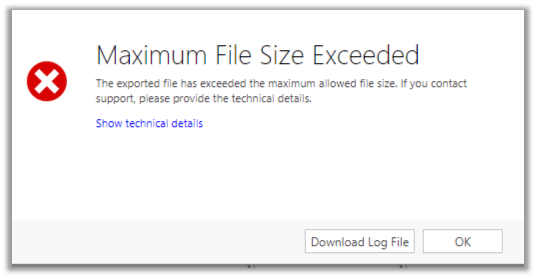
We got this error while trying to export around 70K data through export to excel in Dynamics 365 CE.

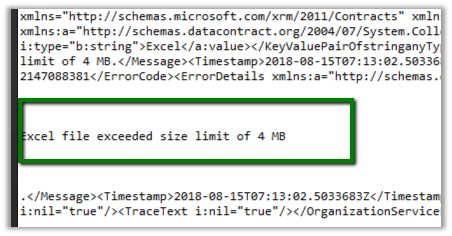
Log file gave us detail of the error i.e. Excel file exceeded size lime of 4 MB.

One workaround is to export small set of data (page wise) by applying some order criteria (either in the Grid or through Advanced Find)

Or better use the wonderful Export to Excel tool in XrmToolBox

https://dreamingincrm.com/2015/05/30/new-xrmtoolbox-plugin-export-to-excel/

It took few mins to export the records in excel and the file size was close to 19 MB.

Hope it helps..

Update/Upsert operation is not supported in non-transaction mode error in Dynamics 365 for Sales Connector of Informatica Cloud


Few weeks back while working on a migration project in which we were using Informatica Cloud’s Dynamics 365 for Sales connector, we used to get the below error while trying to perform the Upsert operation in Batch.

“In CRM WRITER_1_*_1> CCI_WRITER_1000 [ERROR] Update/Upsert operation is not supported in non-transaction mode. “

For this we had raised a support ticket with Informatica. The response we got was that this feature will be available in the new IICS Platform.

So recently we migrated to IICS from ICS and were glad to see this feature available i.e. “performing Upsert operation in Batch“.

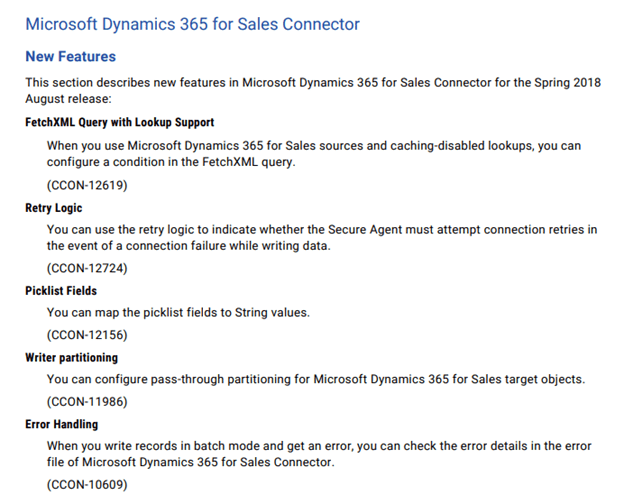
Few other enhancements in the connector includes

Get all the details here

https://kb.informatica.com/proddocs/Product%20Documentation/6/CDI_Spring2018_ConnectorReleaseNotes_en.pdf

Hope it helps..

How we try to speed up IT projects and why it doesn’t work


I had to reblog this !

Hosk's avatarHosk's Dynamic Blog

Code not in production has no value and you don’t know if it will work, get it live in the shortest time possible #HoskCodeWisdom

How does a project get to be a year behind schedule? One day at a time. Fred Brooks

Code not being used by users is worth nothing, you to get a return on investment of creating the code only when it is being used in production by users.
People get lost in the fog of a project and forget its purpose is to create software which helps a business achieves its goals and do the activities which makes the business money.

The goal of IT projects is to create software to help a company deliver its business goals. To help the employees finish tasks and the company to be profitable.

No one cares about technology, employees want to keep their job and the business to be profitable. Technology is…

View original post 1,672 more words

“Cannot update a published workflow definition” exception in Dynamics 365


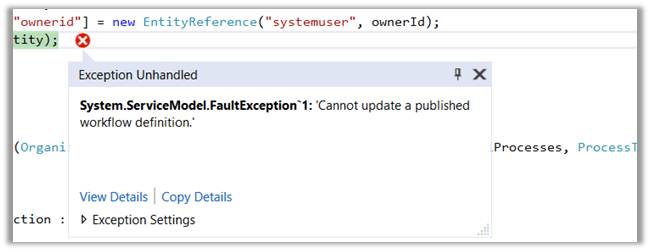
We would get this exception if we try updating an Activated Workflow using Update Request.

So basically, if we need to update the activated\published workflow i.e. Activate or Deactivate it or change the Owner of the workflow, we would need to use the SetState and Assign Request. If we try doing it using the UpdateRequest we will the above error message.

Perform specialized operations using Update

Also, we noticed that if we try changing the state from Deactivated to Activated through Update Request, it will not change the State to Activated and it will not throw an exception as well.

However, if we use Update to Change the Owner for the deactivated workflow, it works fine.

Hope it helps..