Use Monitor to troubleshoot forms in the model-driven app (preview)– Dynamics 365


The new monitor feature added for the Model-driven apps can be used for troubleshooting issues with form related events.

We have 2 ways to access the monitor option.

Select the Model-driven app inside Power Apps  and select Monitor in the command bar.

The other option is to  add the parameter &monitor=true to the end of the URL

And select the monitor option

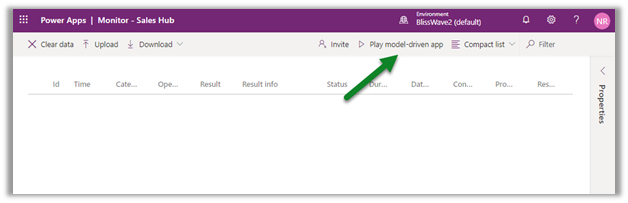
This will open the monitoring session in a new tab.

Click on the Play model-driven app.

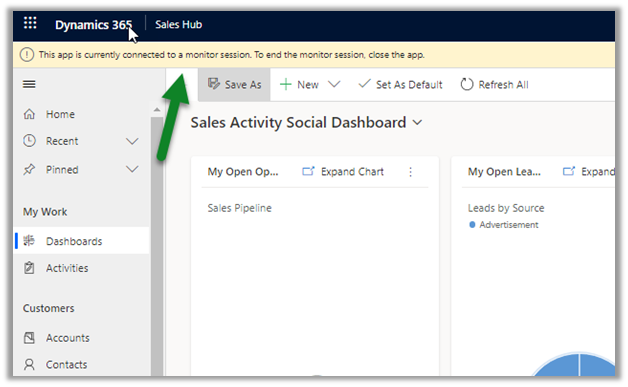
This opens the app connected to the monitor session.

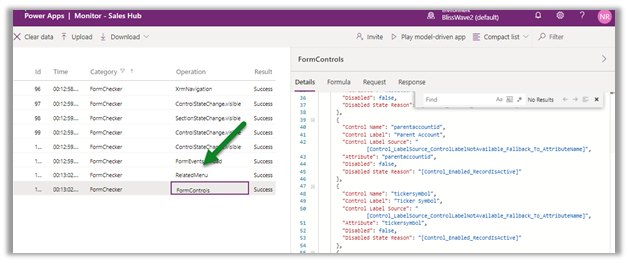
We can see any action performed tracked.

We can filter Category column to check specific events related to form.

Select the row to get the details populated on the right side.

Get all the details below

https://docs.microsoft.com/en-us/powerapps/maker/model-driven-apps/monitor-form-checker

Hope it helps..

Email experience now available in Dynamics 365 Mobile App – 2020 Release Wave 2


With 2020 Release Wave 2, users can now finally compose, edit, and send emails from the Dynamics 365 Mobile App.

Check other blog posts on Release 2020 Wave 2

Now mobile users can –

  • Compose and send email from Dynamics 365 Mobile app

Navigate to Activities menu from the home page.

We can see the Email entity added there.

Clicking on it allows us to compose an email from within the app.

We have the full email editor formatting available.

We also have the functionality of inserting template, signature, knowledge article, etc. available.

We can also create email records from within the Timeline section.

Check the other blog posts on Dynamics 365 Mobile App

Hope it helps..

ARC and SLA Migration tool (Preview) in Dynamics 365 – 2020 Release Wave 2


With 2020 Release Wave 1, new experience was added for administrators which uses Power Automate for defining rules, conditions, and actions for SLA and Automatic create and update records rule.

https://nishantrana.me/2020/02/26/automatic-record-creation-and-update-rules-enhancements-in-dynamics-365-customer-service-2020-release-wave-1/

Now 2020 Release Wave 2 provides a tool to migrate the existing rules and SLA from classic app to the Customer Service Hub that uses Power Automate.

Other blog posts on 2020 Release Wave 2

Say e.g. we have below rule created for Task in the classic or legacy experience.

For the rule item, for simplicity, we have kept the condition as a description field containing data.

Now let us open the Customer Service Hub, and navigate to Service Management Area – ARC and SLA Migration tool

There we can see the 1 rule that we had created listed.


Let us click on the Start Migration button to start the migration.

Let us select the category and click on Next.

The next step is pre-migration check

It shows as passed after the check

The Rules and items to migrate give the option to select the rules to migrate.

The next screen gives the option to review the selection before starting the migration.

Clicking on Start migration starts the process.

Below we can see the migration completed.

Once completed, we are presented with the below summary screen

The new rule has the suffix migrated added to its name.

We can open the rule to check its definition. (and activate it)

As expected we have our rule updated to use the Power Automate.


Below is the rule created in legacy experience.

Note: –

Earlier we got the below error message, which was quickly resolved by Microsoft after it was reported to them.

message=’msdyn_migrationtracker’ entity doesn’t contain attribute with Name = ‘correlationid’ and NameMapping = ‘Logical’. MetadataCacheDetails: ProviderType=Dynamic, StandardCache=True, IsLoadedInStagedContext = False, Timestamp=3625460, MinActiveRowVersion=3625460, MetadataInstanceId=37958858

Dynamics 365 2020 release wave 2 –https://docs.microsoft.com/en-us/dynamics365-release-plan/2020wave2/

Hope it helps..

How to – Use markdown to format approval emails – Power Automate and Dynamics 365


Let us update our previous flow, to use markdown to format the approval email.

Check other posts on Approvals – https://nishantrana.me/2020/08/31/approvals-power-automate-dynamics-365/

Markdown is the lightweight mark-up language for adding formatting elements to the plain text.

Refer the Markdown cheat sheet

We’d update the Details property of Start and wait for an approval action.

Below we have added some sample text that uses markdown syntax.

Below is how it renders in the outlook web access OWA.

And inside the Power Automate Approval Center.

Below we have used markdown syntax for defining the table.

Inside OWA.

Inside the Power Automate approval center.

And within the Power Automate mobile app

Kindly refer to the below table that lists down inconsistencies among different clients.

https://docs.microsoft.com/en-us/power-automate/approvals-markdown-support#client-support

Also check out –

https://www.about365.nl/2020/02/27/power-automate-approvals-markdown-or-html/

https://sharepains.com/2019/07/09/using-markdown-in-microsoft-flow-approval-actions/

Hope it helps..

Advertisements

Custom Responses in Approvals – Power Automate and Dynamics 365


Let us update our previous flow to use Approval Type – Custom Responses, using which we can define our custom response options (instead of limiting ourselves to Approve and Reject)

Check other posts on Approvals – https://nishantrana.me/2020/08/31/approvals-power-automate-dynamics-365/

Here we have updated the Start and wait for an approval action’s Approval Type from

Approve / Reject – First to respond

to

Custom Responses – Wait for one response.

We have defined below custom responses – Accept, Reject, and Need more details.

We have updated the Condition to check for Need more details

Let us save, check, and run the flow.

The approvers are presented with the custom responses

Here among the users to who the request is assigned, the flow will complete if any of the approvers responds, it will not wait for all the approvers to respond.

Now let us update it to use Custom Responses – Wait for all
responses.

Here the flow will wait for responses from all the approvers before moving to the next action.

Lastly, if we define more than 5 responses,

Outlook and OWA have a limitation of only showing the first five responses in the actionable message as shown below.

Within the Power Automate approval center and Power Automate mobile application we do not have this limitation.

Power Automate approval centre:

Power Automate mobile application:

Hope it helps..

Advertisements

Parallel Approvals – Power Automate and Dynamics 365


Let us update our previous flow to include parallel approvals.

Check other posts on Approvals – https://nishantrana.me/2020/08/31/approvals-power-automate-dynamics-365/

The difference between Approve / Reject Type – Everyone must approve and parallel approvals would be that using parallel approvals we could wait for responses for all the approvers, be it approve or reject.

In case of Everyone must approve, if any of the approvers rejects, the request is considered rejected and it will not wait for other approver’s response, and for the request to be considered approved all the approver needs to approve it.

Let us add a new action Add a parallel branch after Apply to each.

Let us keep only test user 1 in the first branch and in the other branch add a Start and wait for an approval action.

We have updated both to be approval type First to respond, set Assigned to the property to test user 1 and test user 2 for the respective branches.

And also we want to evaluate the responses from both the approvers before taking further action, so we have deleted the condition action from the first branch.

Let us add a new Condition action, with 2 AND conditions, i.e. if the first user approves and the second user rejects which corresponds to the respective Start and wait for an approval action.

Here if the condition is fulfilled we update the description of the case record.

Let us save, check, and trigger the flow.

After test user 1 has approved, we can still see the flow waiting for user 2 to respond.

The flow completes successfully after the response is received from both the approvers. Here user 2 rejects the request.

As expected, we can see the description field updated as defined in the update the record action.

Hope it helps..