Microsoft Fakes and LINQ (Custom Workflow Activity) in CRM


Hi,

Just sharing a sample code to test a custom workflow activity using Microsoft Fakes.

The custom workflow activity uses LINQ.

The custom workflow activity code


public sealed class MyCustomWorkflowActivity : CodeActivity
{
#region Public Properties

[Input("Stage Name")]
public InArgument<string> StageName { get; set; }

#endregion

#region Methods

/// <summary>
/// Executes the workflow activity.
/// </summary>
/// <param name="executionContext">
/// The execution context.
/// </param>
protected override void Execute(CodeActivityContext executionContext)
{
// Create the tracing service
var tracingService = executionContext.GetExtension<ITracingService>();

// Create the context
var context = executionContext.GetExtension<IWorkflowContext>();

var serviceFactory = executionContext.GetExtension<IOrganizationServiceFactory>();

IOrganizationService service = serviceFactory.CreateOrganizationService(context.UserId);

try
{
using (var xrmServiceContext = new XrmServiceContext(service))
{
// get the business process workflow id
var workflow = (from w in xrmServiceContext.WorkflowSet
where w.Name == "Business Process Workflow Name"
select new Workflow { WorkflowId = w.WorkflowId }).FirstOrDefault();

if (workflow != null)
{
// get the stage name from the context's input parameter
var stageName = this.StageName.Get<string>(executionContext);
var stage = (from s in xrmServiceContext.ProcessStageSet
where s.StageName == stageName && s.ProcessId.Id == workflow.WorkflowId
select new ProcessStage { ProcessStageId = s.ProcessStageId }).FirstOrDefault();

if (stage != null)
{
// update the sales state in the case record to which the above business process flow is associated
var incident = new Incident
{
Id = context.PrimaryEntityId,
StageId = stage.ProcessStageId
};
service.Update(incident);
}
}
}
}
catch (FaultException<OrganizationServiceFault> e)
{
tracingService.Trace("Exception: {0}", e.ToString());
throw;
}

}

Unit Test Code


public void UnitTestCustomWorkflowActivity()
{

var workflowUserId = Guid.NewGuid();
var workflowCorrelationId = Guid.NewGuid();
var workflowInitiatingUserId = Guid.NewGuid();

var service = new Microsoft.Xrm.Sdk.Fakes.StubIOrganizationService();

var workflowContext = new Microsoft.Xrm.Sdk.Workflow.Fakes.StubIWorkflowContext();
workflowContext.UserIdGet = () =>
{
return workflowUserId;
};
workflowContext.CorrelationIdGet = () =>
{
return workflowCorrelationId;
};
workflowContext.InitiatingUserIdGet = () =>
{
return workflowInitiatingUserId;
};

// ITracingService
var tracingService = new Microsoft.Xrm.Sdk.Fakes.StubITracingService();
tracingService.TraceStringObjectArray = (f, o) =>
{
Debug.WriteLine(f, o);
};

// IOrganizationServiceFactory
var factory = new Microsoft.Xrm.Sdk.Fakes.StubIOrganizationServiceFactory();
factory.CreateOrganizationServiceNullableOfGuid = id =>
{
return service;
};

SetBpfStage target = new SetBpfStage();

var wfEntity = new Workflow();
wfEntity.Id = Guid.NewGuid();
wfEntity["name"] = "abcabcabc";
var wfEntity1 = new Workflow();
wfEntity1.Id = Guid.NewGuid();
wfEntity1["name"] = "abcabcabc";

var processStageEntity = new ProcessStage();
processStageEntity.Id = Guid.NewGuid();
processStageEntity["name"] = "abcabcabc";
service.ExecuteOrganizationRequest = r =>
{
RetrieveMultipleResponse response = null;
if (((Microsoft.Xrm.Sdk.Query.QueryExpression)((RetrieveMultipleRequest)r).Query).EntityName
== "workflow")
{
List<Entity> entities = new List<Entity> { wfEntity };

response = new RetrieveMultipleResponse
{
Results =
new ParameterCollection
{
{
"EntityCollection",
new EntityCollection
(entities)
}
}
};

return response;
}

if (((Microsoft.Xrm.Sdk.Query.QueryExpression)((RetrieveMultipleRequest)r).Query).EntityName
== "processstage")
{

List<Entity> entities = new List<Entity> { processStageEntity };

response = new RetrieveMultipleResponse
{
Results =
new ParameterCollection
{
{
"EntityCollection",
new EntityCollection
(entities)
}
}
};

return response;
}

return response;
};

service.UpdateEntity = (p) =>
{
};

var invoker = new WorkflowInvoker(target);
invoker.Extensions.Add<ITracingService>(() => tracingService);
invoker.Extensions.Add<IWorkflowContext>(() => workflowContext);
invoker.Extensions.Add<IOrganizationServiceFactory>(() => factory);

var inputs = new Dictionary<string, object>
{
{ "StageName", "New" }
};

invoker.Invoke(inputs);
}

Hope it helps..

Using LINQ in CRM 2013


There are few ways we can make use of LINQ to write queries against CRM.

Using the early bound entity classes along with the generated service context

Use the CrmSvcUtil tool to generated the early bound entity classes and service context

CrmSvcUtil.exe /url:http://<serverName>/<organizationName>/XRMServices/2011/Organization.svc

/out:<outputFilename>.cs /username:<username> /password:<password> /domain:<domainName>

/namespace:<outputNamespace> /serviceContextName:<serviceContextName>


Uri organizationUri = new Uri("http://server/orgname/XRMServices/2011/Organization.svc");
 Uri homeRealmUri = null;</pre>
<pre> ClientCredentials credentials = new ClientCredentials();
 credentials.Windows.ClientCredential = new System.Net.NetworkCredential("username", "password", "domain");
 OrganizationServiceProxy orgProxy = new OrganizationServiceProxy(organizationUri, homeRealmUri, credentials, null);
 orgProxy.EnableProxyTypes();
 IOrganizationService _service = (IOrganizationService)orgProxy; 
 
 var xrmServiceContext = new XrmServiceContext(_service);
 // get all contact record that has first name as Hugh
 var lstContact = (from c in xrmServiceContext.ContactSet
 where c.FirstName == "Hugh"
 select c).ToList();
 foreach(var contact in lstContact)
 {
 MessageBox.Show(contact.FullName);
 }


Using Early bound entity classes and OrganizationServiceContext

Suppose we have the early bound entity classes but haven’t generated the service context. In this case we can use OrganizationServiceContext


var xrmServiceContext = new OrganizationServiceContext(_service);

var lstContact = (from c in xrmServiceContext.CreateQuery<Contact>()
 where c.FirstName == "Hugh"
 select c).ToList();

foreach (var contact in lstContact)
 {
 MessageBox.Show(contact.FullName);
 }

Using Late bound and OrganizationServiceContext

Suppose we are not generating the early bound classes and using late binding


  var xrmServiceContext = new OrganizationServiceContext(_service);

 var lstContact = (from c in xrmServiceContext.CreateQuery("contact")
 where c["firstname"] == "Hugh"
 select c).ToList();

 foreach (var contact in lstContact)
 {
 MessageBox.Show(contact["fullname"].ToString());
 }

Hope it helps..


“the specified type is not a known entity type” error while using early bound entity classes in CRM 2013


Hi,

We were writing a custom workflow activity that was using LINQ (early bound).

Here we had used ILMerge to merge the early bound assemblies with the workflow assembly.

The solution was to place the following attribute in the AssemblyInfo.cs of the workflow assembly (same goes for Plugin Assembly)

[assembly: Microsoft.Xrm.Sdk.Client.ProxyTypesAssemblyAttribute()]


The helpful thread

http://social.microsoft.com/Forums/en-US/7c05f900-f930-46b3-a233-75a94ffca9c5/how-to-make-the-crm-2011-plugin-detect-types-from-early-bound-organisation-class?forum=crmdevelopment

Hope it helps..


OptionSetId cannot be changed. EnumAttributeInfo.AttributeDescription.OptionSetId(089e077e-6055-446a-ad6e-326f0bee7c9c) != c0864f8b-2c13-e411-93ed-000d3a800961


We got this error while importing the solution. This issue is caused by having an optionset with same name but different guid.

The solution is to identify the field and delete it from the org where we are importing.

select name from optionsetview where optionsetid = ‘c0864f8b-2c13-e411-93ed-000d3a800961’ (the 2nd guid)

The helpful post

http://atriosystems.wordpress.com/2012/11/12/import-unmanaged-solution-error-optionsetid-cannot-be-changed/

Bye

Fix: Invalid ‘where’ condition. An entity member is invoking an invalid property or method while using LINQ in CRM 2013.


Hi,

We were writing a LINQ query to get the contract record information by passing in the lawyer name. The lawyer is a lookup in the contract record.

So we were using contract.lawyerid.Name field of lookup in our where condition.

However we got the below error while doing so..


It seems like the LINQ Implementation for CRM doesn’t correctly interpret the lookup field’s name if we are using it in the where clause.

The solution was to do a join between the entities and then use the where condition against the lawyer entity username field itself.

Hope it helps..

Sample HttpModule for CRM 2013 on premise.


Suppose we have to redirect user belonging to a specific group to some specific page, while they try to access CRM 2013.

For this we can implement an HttpModule

Sample code


public class Class1 : IHttpModule
{
public void Dispose()
{

}
public delegate void MyEventHandler(Object s, EventArgs e);
private MyEventHandler _eventHandler = null;

public event MyEventHandler MyEvent
{
add { _eventHandler += value; }
remove { _eventHandler -= value; }
}
public void Init(HttpApplication context)
{
context.AuthenticateRequest += new EventHandler(ContextOnAuthenticateRequest);
}

private void ContextOnAuthenticateRequest(object sender, EventArgs eventArgs)
{
HttpApplication app = sender as HttpApplication;
HttpContext context = app.Context;

// if the user belongs to adminsitrators role or reporting group
// redirect the user to bing.com
if (context.User.IsInRole(@"BUILTIN\Administrators") &&
context.User.IsInRole(@"LSS\ReportingGroup {0993772e-cfb6-47ba-8b88-2129bfc97f89}"))
{
app.Context.Response.Redirect("http://www.bing.com");
}

if (_eventHandler != null)
_eventHandler(this, null);
}
}


Put the dll in the bin of the CRMWeb

..\Microsoft Dynamics CRM\CRMWeb\bin

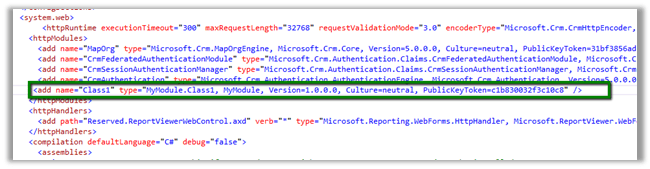
And register the http module in the web.config

(use sn –T MyModule.dll to get the public key token)

Moreover this can be implemented using URLRewrite as it runs before the authentication so we wont be able to get the username

http://www.iis.net/downloads/microsoft/url-rewrite

Hope it helps