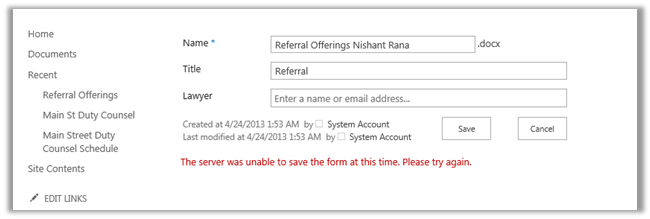
“Application definition import failed. The following error occurred: Settings or services required to complete this request are not currently available” error while importing BDC model file in SharePoint 2013 online.


Hi,

I created a BDC model file for one of my projects (Using SharePoint Designer 2010) and now when I am trying to import it in SharePoint 2013 online (Office 365 Preview) environment I am getting the below error.


And the surprising part is I am able to import the same file without any issues in my other Office 365 preview environment.

Not sure why I am getting the above, may be the service is down as the message suggests for that particular environment or something. Will post the solution if I am able to find one.

Bye.

Hiding SharePoint:FormField in list forms


The easiest way to hide a SharePoint form field inside form is to wrap up it in inside XSl:IF condition,

In the below example, we are giving a condition which would always be true to hide the form field named Country in the form.

<xsl:if test=”1 = 2″>

<SharePoint:FormField runat=”server” id=”ff1{$Pos}” ControlMode=”New” FieldName=”Country” __designer:bind=”{ddwrt:DataBind(‘i’,concat(‘ff1′,$Pos),’Value’,’ValueChanged’,’ID’,ddwrt:EscapeDelims(string(”)),’@Country’)}” />

</xsl:if>

Select the Field within SharePoint designer, right click and select Conditional Formatting

And specify the show or hide condition in the Conditional Formatting dialog box

Hope it helps.

“The Business Data Connectivity Metadata Store is currently unavailable” error in SharePoint Designer 2013 Preview


Hi,

I recently wrote a WCF service as a wrapper over CRM 2011 online and hosted it in Azure. The intent was to use this WCF service as BCS connection to integrate CRM 2011 online with SharePonit 2013 online. I tested the service with WCF Test Client and it was working fine.

The next step was to create an External Content Type in SharePoint Designer 2013. On selecting the External Content Types link inside SharePoint designer I kept getting the below error.

Next I used SharePoint Designer 2010 to connect to the SharePoint 2013 online site. There it didn’t throw the Metadata Store is currently available error.

However I kept getting the following error while trying to create a new external content type.

The workaround was to connect to SharePoint 2010 online site through SharePoint Designer 2010 and then generating the BCS Model from therein using our Azure Hosted WCF Service.

Hope it helps.


Using RetrieveMetadataChangesRequest class (Metadata Querying) in Polaris (CRM 2011)


Hi,

Let us take a very simple example to understand RetrieveMetadataChangesRequest class introduced in Polaris.

In this example we will retrieve information about all the attributes for contact entity where attribute type is of lookup.

For this we will use the RetrieveMetadataChangesRequest class.

This class contains the data which specifies the metadata information that needs to be retrieved.

RetrieveMetadataChangesRequest class has a Query property that accepts an EntityQueryExpression.

RetrieveMetadataChangesRequest retrieveMetadataChangesRequest = new
RetrieveMetadataChangesRequest()
{
Query = entityQueryExpression
};

EntityQueryExpression class defines the query to retrieve the metadata information.

Here we will need to set the following three properties of the EntityQueryExpression class


EntityQueryExpression entityQueryExpression = new
EntityQueryExpression()
{
Criteria = EntityFilter,
Properties = EntityProperties,
AttributeQuery = new
AttributeQueryExpression()
{
Criteria = AttributeFilter,
Properties = AttributeProperties
}
};
  • Criteria – specifies the filter criteria like for which entities we want metadata information to be retrieved.
  • Properties –
    specifies the properties to be returned.
  • AttributeQuery – specifies the criteria and properties for the entities attribute metadata like which type of attribute to retrieve and what all information to be retrieved for that attribute.

Specfying EntityFilter

This is how we will specify that we need metadata information for only the contact entity.

Specifying Properties of the Entity to be retrieved

Here we are specifying all the properties to be returned

MetadataPropertiesExpression EntityProperties = new
MetadataPropertiesExpression() { AllProperties = true };


Here we can set the AllProperties as false and instead specify the property names that we want to retrieve as shown below

EntityProperties.PropertyNames.Add(“AttributeType”);

Specifying the lookup attribute to be retrieved

MetadataConditionExpression metadataconditionexpressionEntity = new
MetadataConditionExpression();
metadataconditionexpressionEntity.PropertyName = "SchemaName";
metadataconditionexpressionEntity.Value = "Contact";
metadataconditionexpressionEntity.ConditionOperator = MetadataConditionOperator.Equals;
MetadataFilterExpression EntityFilter = new MetadataFilterExpression(LogicalOperator.And);
EntityFilter.Conditions.Add(metadataconditionexpressionEntity);

Specifying the properties to be retrieved for the lookup attribute

Here we are specifying that we only need the AttributeType and Description information for the Lookup attributes retrieved.

MetadataPropertiesExpression AttributeProperties = new
MetadataPropertiesExpression() { AllProperties = false };
AttributeProperties.PropertyNames.Add("AttributeType");
AttributeProperties.PropertyNames.Add("Description");

Full sample code

// specifying EntityFilter to only include entity having SchemaName as contact

MetadataConditionExpression metadataconditionexpressionEntity = new
MetadataConditionExpression();
metadataconditionexpressionEntity.PropertyName = "SchemaName";
metadataconditionexpressionEntity.Value = "Contact";
metadataconditionexpressionEntity.ConditionOperator = MetadataConditionOperator.Equals;
MetadataFilterExpression EntityFilter = new MetadataFilterExpression(LogicalOperator.And);
EntityFilter.Conditions.Add(metadataconditionexpressionEntity);

// specfying EntityProperties to include the properties to be retrieved
MetadataPropertiesExpression EntityProperties = new
MetadataPropertiesExpression() { AllProperties = true };
MetadataConditionExpression metadataExpression = new
MetadataConditionExpression("AttributeType", MetadataConditionOperator.Equals, AttributeTypeCode.Lookup);
MetadataFilterExpression AttributeFilter = new
MetadataFilterExpression(LogicalOperator.And);
AttributeFilter.Conditions.Add(metadataExpression);

//A Properties expression to limit the properties to be included with attributes
MetadataPropertiesExpression AttributeProperties = new
MetadataPropertiesExpression() { AllProperties = false };
AttributeProperties.PropertyNames.Add("AttributeType");
AttributeProperties.PropertyNames.Add("Description");

//An entity query expression to combine the filter expressions and property expressions for the query.
EntityQueryExpression entityQueryExpression = new
EntityQueryExpression()
{
Criteria = EntityFilter,
Properties = EntityProperties,
AttributeQuery = new
AttributeQueryExpression()
{
Criteria = AttributeFilter,
Properties = AttributeProperties
}
};

RetrieveMetadataChangesRequest retrieveMetadataChangesRequest = new
RetrieveMetadataChangesRequest()
{
Query = entityQueryExpression
};
RetrieveMetadataChangesResponse retrieveMetadataChangesResponse = (RetrieveMetadataChangesResponse)_service.Execute(retrieveMetadataChangesRequest);
EntityMetadata entityMetadata = retrieveMetadataChangesResponse.EntityMetadata[0];
foreach (AttributeMetadata attMetadata in entityMetadata.Attributes)
{
MessageBox.Show(attMetadata.Description.UserLocalizedLabel.Label);
}

Hope it helps.

ExecuteMultipleRequest message in Polaris (CRM 2011)


Using ExecuteMultipleRequest class we can now execute one or more message requests as a single batch.

For example in the code below we are creating 3 contact entity record as well as deleting one of the contact records as a single batch.

Here below, we are first initializing 3 contact entity record, then creating the associated CreateRequest and DeleteRequest.

We are then adding all these requests to OrganizationRequestCollection which we then use for the Requests property of the ExecuteMutlipleRequest class. The request are executed in the order in which they are added to the OrganizationRequestCollection.

Settings Property defines whether execution should continue if an error occurs and if responses for each message request processed are to be returned or not.

// Create 3 contact entitiy's record
Entity entity1 = new Entity("contact");
entity1.Attributes["lastname"] = "lastname1";
Entity entity2 = new Entity("contact");
entity2.Attributes["lastname"] = "lastname2";
Entity entity3 = new Entity("contact");
entity3.Attributes["lastname"] = "lastname3";
// Create CreateRequest and Delete Request
CreateRequest createReq1 = new CreateRequest();
createReq1.Target = entity1;
CreateRequest createReq2 = new CreateRequest();
createReq2.Target = entity2;

// DeleteRequest with incorrect guid to throw error

DeleteRequest deleteReq = new DeleteRequest();
deleteReq.Target = new EntityReference("contact", Guid.NewGuid());

CreateRequest createReq3 = new CreateRequest();
createReq3.Target = entity3;

// Initialize OrganizationRequestCollection

OrganizationRequestCollection orgReqCollection = new OrganizationRequestCollection();
orgReqCollection.Add(createReq1);
orgReqCollection.Add(createReq2);
orgReqCollection.Add(deleteReq);
orgReqCollection.Add(createReq3);

// Intialize ExecuteMultipleRequest

ExecuteMultipleRequest executeMutlipleRequest = new ExecuteMultipleRequest();
executeMutlipleRequest.Requests = orgReqCollection;
executeMutlipleRequest.Settings = new ExecuteMultipleSettings();

// ContinueOnError - specifies whether to continue in case of error in any of the request or not
executeMutlipleRequest.Settings.ContinueOnError = false;

// ReturnResponses - specifies whether to return responses for the requests or not
executeMutlipleRequest.Settings.ReturnResponses = true;

ExecuteMultipleResponse executeMulResponse = (ExecuteMultipleResponse) _service.Execute(executeMutlipleRequest);

In the above example we are deliberately throwing exception for the DeleteRequest.

So if we are setting the ContinueOnError property as false, our program will create the first two contact record and then throws exception.

Contact Records Created:

Exception:

And if we are setting the ContinueOnError as true, our program will create all the three contact records and for the DeleteRequest it will return the error message as a part of response as we have set the ReturnResponses as true.

All the three contact records created:

ExecuteMultipleResponse:

Here we get 4 responses one for each of the requests in OrganizationCollectionRequest.

IsFaulted property of the ExecuteMultipleResponse has value as true as we get a FaultException in case of DeleteRequest.

The Message for the DeleteRequest gives us the error message.

The response for the CreateRequest contains the Guid of the contact record created.


Hope it helps

“Network Error” while calling WCF Service through JavaScript.


Hi,

I was getting the following “Network Error” on calling WCF Service using XMLHttpRequest within an html page through JavaScript.

I was using IE 10 in a Windows 8 machine.

After some searching found out that this is a known issue.

http://bugs.jquery.com/ticket/12790

Running the same in compatibility mode worked properly.

Hope it helps.

Nishant Rana's Weblog

Everything related to Microsoft .NET Technology

Skip to content ↓